Convection roasting browned everything down the right side. He measured cavity temperature at four corners, found the fan motor slowing under heat and replaced it. A whole tray of vegetables now cooks evenly.
Buying and owning
Fitting a professional range into a 1920s kitchen
The three things that go wrong when a modern professional range meets a hundred-year-old kitchen: the opening is undersized, there is no dedicated 20A circuit, and the floor is no longer level.
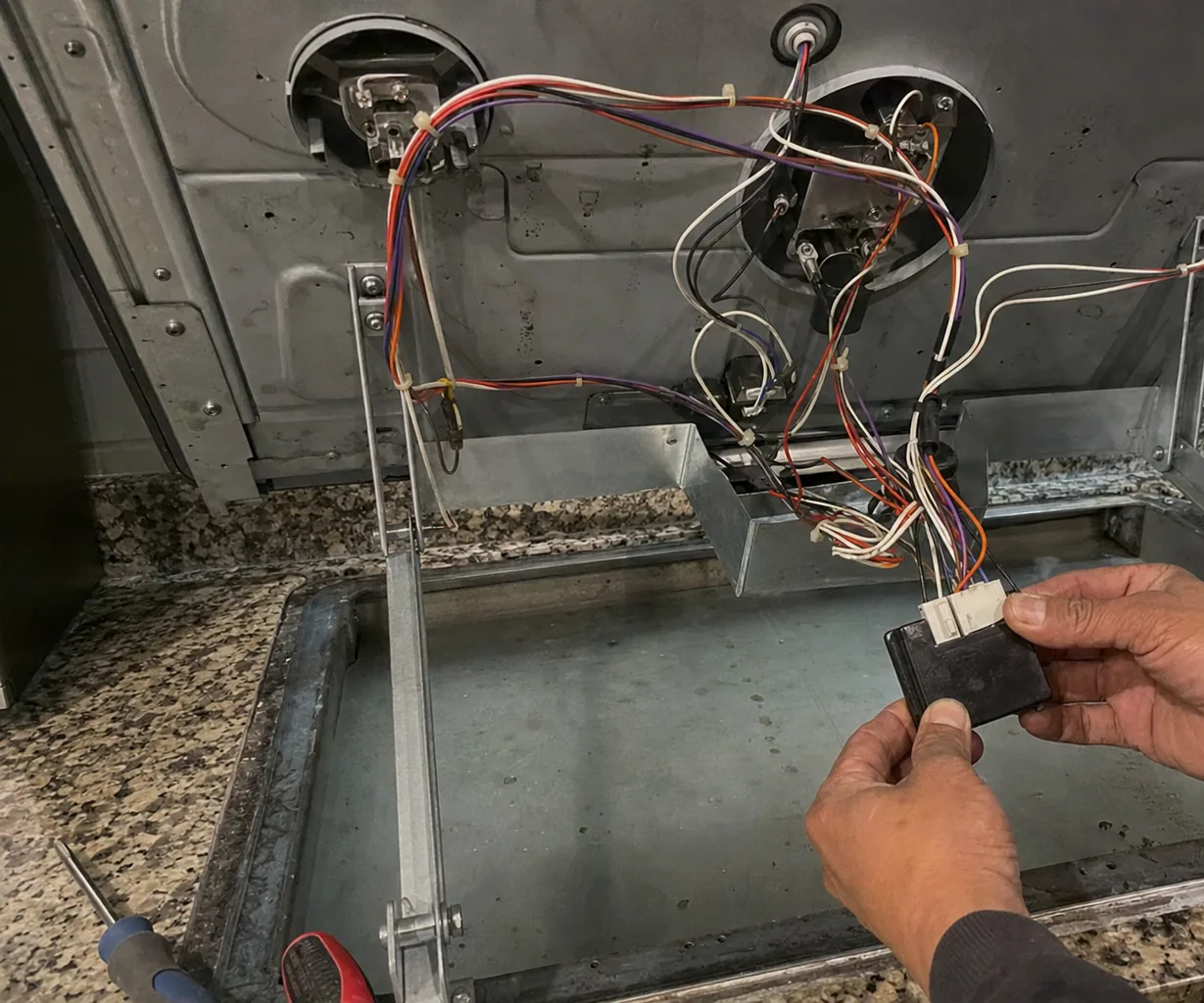
Older kitchens were wired for older appliances. A circuit that sags under load imitates almost every electronic fault there is.
Article
Fitting a professional range into a 1920s kitchen
The mismatch
Kitchens in Riverside, Avondale and Old Ortega were laid out between roughly 1900 and 1930 for equipment that no longer exists. Those houses have been remodelled once or twice since, usually by fitting new cabinets around the room that was already there rather than by rebuilding the room.
Then somebody drops a 36 or 48 inch professional range into it. Three things bite, in this order.
1. The opening
Cabinet runs in these houses were built to whatever the carpenter did that year, not to a modern 30 or 36 inch module. We regularly find a nominal 36 inch range in an opening that measures 35 and three quarters, held in place by trim that was scribed to close the gap.
That is not just an installation nuisance. It means the range cannot come forward for service without the trim, and sometimes the adjacent cabinet, coming off first. Anything that needs rear access, which includes the gas connection, a good deal of the wiring and any board mounted at the back, becomes a much bigger job than the same repair in a 2005 kitchen in Nocatee.
Depth is the other half of it. Original walls are rarely straight, and a professional range needs its stated clearance behind the back panel. A range shimmed forward to clear a bowed plaster wall now overhangs the counter, and the door sweeps into the island.
2. The circuit
A professional gas range needs power. Ignition modules, the control board, the oven convection fan, interior lighting and on many models the oven safety circuit all run on it. A dual fuel range needs a great deal more, and a 240V supply.
Original wiring in these houses did not include a dedicated 20A circuit at the counter, because nothing in 1926 needed one. Retrofits usually tapped what was available. The result is a kitchen circuit already carrying a refrigerator and a microwave, with the range added to it. The breaker trips, the range is blamed, and a technician gets called for an electrical fault that is not in the appliance.
We check supply voltage under load on every call. If the problem is the circuit we will tell you, and you want an electrician rather than us.
3. The floor
Hundred-year-old floors move. A range levelled in 2009 is not level in 2026.
This matters more than people expect. An oven door that will not stay shut, or that swings open on its own, is frequently a levelling problem and not a hinge problem. So is a door that seals at the bottom and leaks heat at the top. We put a level on the range before we quote hinges, because hinges on a heavy professional door are not a cheap part and there is no point fitting them to fix a floor.
What to check before you buy
If you are putting a professional range into one of these kitchens, get four measurements and one answer before you order.
- Width of the opening at the narrowest point, including trim
- Depth from the finished wall to the front of the counter
- Height from the finished floor to the underside of any overhead, and whether the hood clears
- Whether the floor is level across the full width of the opening
- Whether there is a dedicated circuit of the correct rating for the model you want
Also look at the hood. A high-capacity hood over a professional cooktop in a tightly retrofitted house can pull enough air to lie a simmer flame over. In an old house with plenty of leakage that is less common, but a house that has been fully sealed and re-insulated behaves like a new one.
Ventilation routing
Duct runs in old houses are a compromise by definition. There is rarely a straight path from the hood collar to the outside, so the run picks up elbows and length, and every one of those costs airflow. A hood that has never pulled properly since it was installed usually has a duct problem, not a blower problem, and no part we could sell would fix it.
Questions
Follow-ups
Does a gas range need electricity?
Yes. Ignition, controls, oven convection fan, lighting and on many models the oven safety valve all need power. A gas range in a house with no dedicated circuit still has an electrical problem waiting.
Can you tell me if a range will fit before I buy it?
We can measure the opening, the depth to the wall, the trim, the gas run and the circuit and tell you what is involved. That is a far cheaper conversation than a delivery that will not go in.
Price Bands
What does a repair cost, band by band?
Parts and labour together, in the bands these jobs land in. The $80 diagnostic comes off the bill when you approve the work, and the firm figure is written down after the fault is proved.
| Work | Typical range |
|---|---|
| Diagnostic visit | $80 |
| Control board or touch panel | $390–$930 |
| Igniter or burner assembly | $200–$570 |
| Oven thermostat or heating element | $190–$550 |
If This Is Your Problem
The appliances this affects
Sealed burners, spark modules, oven temperature drift and the door hinges that carry a 40-pound door. 30, 36, 48 and 60 inch ranges, gas and dual fuel.
Drop-in rangetops in 30, 36, 48 and 60 inch widths. Burner and valve work, simmer faults, griddle and grill module repair, and the counter cut-out problems nobody warned you about.
Wall, island and professional hoods with internal, inline or remote blowers. Motor and speed control faults, lighting, baffle and duct problems, make-up air diagnosis.
Where It Bites
Areas where this one matters most
These are the service-area pages that turn on this problem. Each one carries its own published figures rather than repeating this article.
Two different service problems in one city. Modern built-ins on the Southside, and 1900s to 1930s kitchens with undersized openings in Riverside, Avondale and Ortega.
Keep Reading
Next article
Surge damage is rarely instant. A board takes a hit, keeps working, and fails days later. Understanding that changes what a technician should test first and what protection is worth buying.
Burners, valves, hinges and thermostats stay available for decades. Electronics do not. Test the board first, then decide, and you will not put good money into a machine with no future.
Customer Comments
What customers said afterwards
4.8 out of 5, across 90 customer reviews. Every one is a single visit, in the words of the person whose kitchen it happened in.
A burner lit and then dropped out the moment the knob was released. He found a tired flame sensor and a loose spade connector behind the manifold, replaced one and remade the other, then tested the lot.
The oven in our range would climb past the set point and sit there. He checked the sensor resistance cold, found it reading low, and swapped it. Then he stayed to watch two full cycles before he called it done.
Next Step
Book a diagnostic
Give us the model number and what it is doing. We quote in writing before anything comes apart.
- $80 diagnostic, credited
- 90-day labor
- 365-day parts
- Mon-Fri 8am-6pm. Sat 9am-4pm. Closed Sunday.