Our range top would light on the left and not the right. He found the spark module burnt on one output and the ground strap loose under the chassis. Both put right, and he cleaned the burner ports while he had them off.
Ranges
Viking professional range repair
Sealed burners, spark modules, oven temperature drift and the door hinges that carry a 40-pound door. 30, 36, 48 and 60 inch ranges, gas and dual fuel.
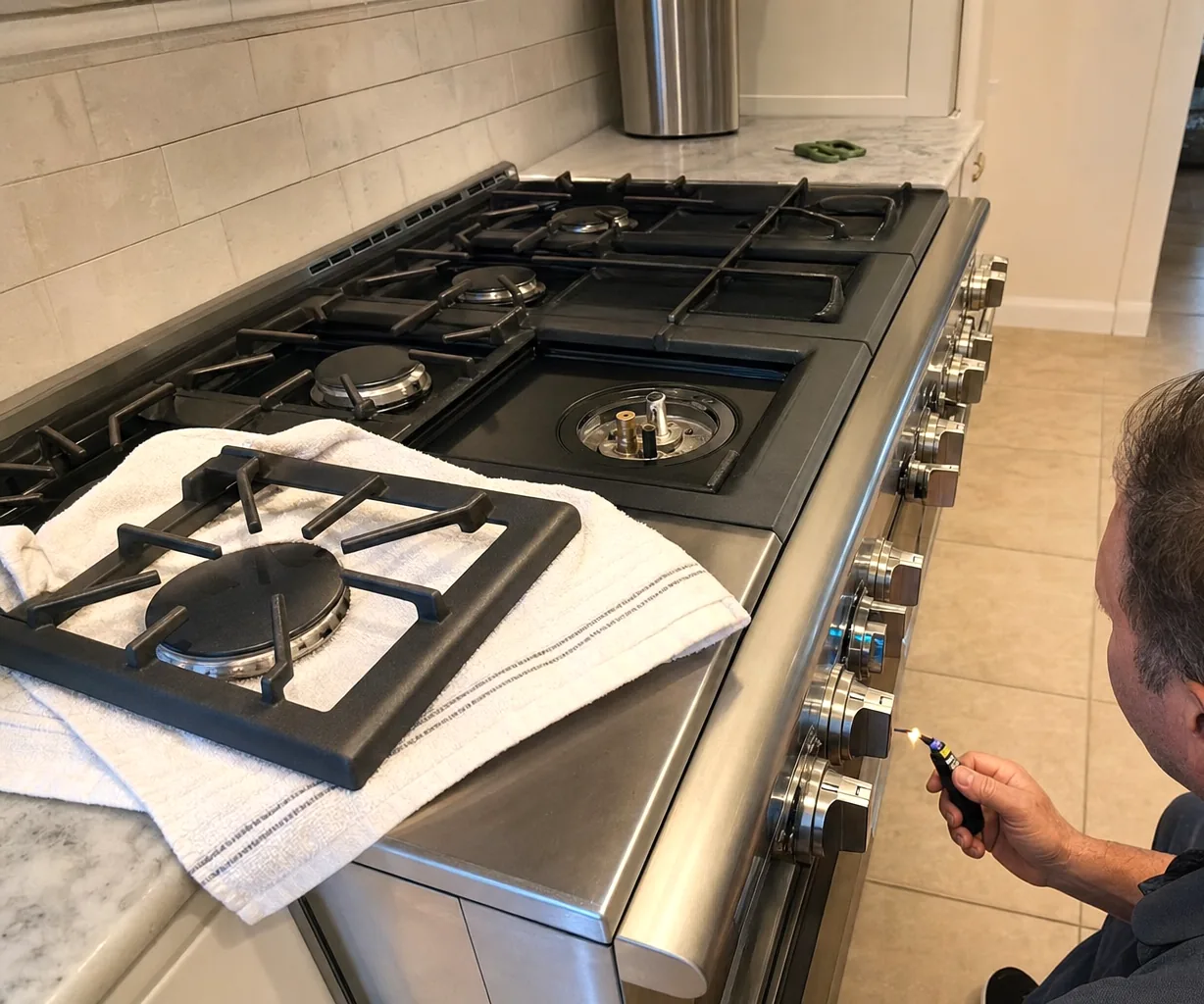
A sealed burner that clicks and will not catch is nearly always the electrode or the port, and both are reachable in the first ten minutes.
Symptoms
What you are seeing, and what it usually is
Described from the owner's side. No invented error codes. Where the cause is not certain, what gets checked is listed rather than guessed at.
| Observed | Usually | The work |
|---|---|---|
| Burner clicks but will not light | Fouled or cracked igniter electrode, a burner cap seated wrong after cleaning, or a spark module firing weak. | Reseat and clean the cap and electrode, check the spark gap, read the module output, replace the igniter if the ceramic is cracked. |
| All burners spark at once and keep sparking | Water or grease bridging one electrode. The module fires every electrode on the manifold, so one wet burner makes the whole cooktop tick. | Dry and clean the offending electrode, check the harness for chafe, replace the module only if it still fires with all electrodes disconnected. |
| Oven reads 350 but bakes like 315 | Drifted temperature sensor, a weak bake element, or a gas oven valve not opening fully. | Measure sensor resistance cold, log actual cavity temperature over three cycles, replace the sensor or the valve, then re-check. |
| Oven door sags, hangs open at the bottom, or slams the last two inches | Hinge spring fatigue. A pro-range door is heavy and the springs work every time it opens. | Replace hinges as a pair, reset the door to the frame, verify the gasket seals all the way round. |
| Simmer setting will not hold a low flame | Blocked burner ports, wrong orifice after an LP conversion, or a valve that has lost its bypass adjustment. | Clear the ports, confirm the orifice matches the gas supply, adjust or replace the valve. |
| Convection fan noisy or not turning | Worn fan motor bearing, or a blade fouling the baffle after the baffle was refitted crooked. | Pull the baffle, check blade clearance, replace the motor if the bearing is dry. |
| Igniter keeps clicking after the burner is lit | One electrode bridged by moisture or cooking residue, so the module never sees a proven flame on that burner and keeps sparking the whole manifold. | Find the bridged electrode with the kitchen darkened, clean and dry the ceramic, check cap seating and spark gap, replace the electrode if the ceramic is cracked. |
| Range dead after a storm | Failed control board or a tripped breaker. About 68 thunderstorm days a year in this metro means surge damage is a routine call, not a rare one. | Confirm supply voltage, inspect the board for burnt traces, replace and recommend a surge device at the panel. |
Price Bands
What does a professional ranges repair cost?
Parts and labour together, in the bands these jobs land in. The $80 diagnostic comes off the bill when you approve the work, and the firm figure is written down after the fault is proved.
| Work | Typical range |
|---|---|
| Diagnostic visit | $80 |
| Igniter or burner assembly | $200–$570 |
| Control board or touch panel | $390–$930 |
| Oven thermostat or heating element | $190–$550 |
Detail
How we approach it
The category, and why it matters to the repair
Viking put the first professional-style range into a residential kitchen in 1987. Everything that followed in the category copied the format: commercial construction, welded frames, cast iron grates, sealed high-output burners, and a door heavy enough that the hinges became a wear item.
That construction is the reason these ranges are worth fixing. A mass-market range is a stamped box with a printed board inside it. A professional range is a serviceable machine. Burners come apart. Valves are individually replaceable. Hinges bolt out. Twenty and thirty year old units still take parts.
What actually breaks
Four things account for most of the range calls we run.
Ignition. The spark electrode sits at the edge of the burner where boil-overs land. Sugar, salt water and cleaner residue build a conductive path across the ceramic, and the spark takes the easy route to the burner body instead of jumping the gap. The burner clicks and clicks and never lights. On a well-fed gas supply this is usually a cleaning job, not a parts job.
Oven temperature. Owners describe it as the oven getting weaker. What it usually is: a temperature sensor whose resistance curve has drifted, or, on a gas oven, a valve that is opening late. We measure the sensor cold, then log the cavity with an independent probe across three full cycles. A range that overshoots on the way up and undershoots at the end is telling you something different to one that simply reads 30 degrees low the whole time.
Door hardware. The door on a 48 inch range is a real weight, and the hinge springs carry that weight every single day. When they tire, the door sags at the front edge, the gasket stops sealing at the top, and the oven loses heat out of the corner. People then blame the thermostat. Hinges go in as a pair. Replacing one leaves the door twisted.
Control boards. This metro sees roughly 68 thunderstorm days a year. Boards fail after power events, usually in the days following rather than during. If a range went dead the week after a storm, we check the board before anything else.
Getting the range out, and putting it back level
A professional range is heavy, it is deep, and the things that need reaching — the gas connection, the outlet, the ignition module, the convection motor — are all behind or beneath it. So the move is part of the job, not a preliminary to it.
The gas shutoff gets closed and the circuit gets killed before anything travels. The unit comes forward onto floor protection, because these ranges are heavy enough to mark hardwood, tile and stone without much help. The anti-tip bracket, where one is fitted, gets refitted properly on the way back in; it is a safety device on an appliance with a heavy door and a heavy oven rack load.
Then it goes back level, checked with a level rather than by eye. That last step matters more than it sounds. A range that goes back a fraction out of level will bring us back for an oven door that will not stay shut, and the door will not be the actual fault.
Whether it is worth repairing at all
It nearly always is, and the sum is published rather than asserted. Ignition work, oven heat and door hardware on a professional range are a small fraction of what the machine costs new, and the parts that make that true - burners, valves, igniters, hinges - are still made. The one thing that ends a range early is an obsolete control board, which is why the board is tested before anything else is quoted. The arithmetic, band by band against replacement, is on the repair or replace page.
How we work
Flat $80 diagnostic, credited to the repair when you approve it. Written estimate before anything comes apart. 90 days on labor, 365 days on parts, genuine OEM parts only.
We are an independent shop. No manufacturer contract, no warranty administrator deciding what gets replaced, no quota. When a part is not worth fitting to a particular range, we say so and tell you why.
Job Data
Scope and terms for this appliance
| Item | Detail |
|---|---|
| Widths serviced | 30, 36, 48 and 60 inch |
| Diagnostic | $80 |
| Estimate | In writing, before work starts |
| Labor warranty | 90 days |
| Parts warranty | 365 days |
| Typical first visit | 60 to 90 minutes |
Questions
Asked on most of these calls
Do you work on ranges from the 1990s?
Yes. Burners, valves, igniters, hinges and thermostats are still available for most of the early professional ranges. The parts that go obsolete first are electronic control boards, which is why we test the board before quoting.
Do I need to pull the range out?
Not before we arrive. Most burner, igniter and door work happens from the front. If the job needs rear access we move the range ourselves and protect the floor.
Can you convert a range between natural gas and propane?
We can fit the correct orifices and adjust the valves where the manufacturer publishes a conversion for that model. We will not improvise a conversion that was never offered.
How long does a Viking range last?
Longer than most owners assume. These were built as commercial-style equipment for a house: heavy gauge steel, welded frames, serviceable assemblies. Ranges from the 1990s are still taking burner, valve, igniter and hinge parts. What usually ends one is an obsolete control board, not worn metal, which is why we test the board before quoting anything else and say plainly when the numbers stop making sense.
Why does my igniter keep clicking after the burner lights?
Because the spark module fires every electrode on the manifold together and carries on while the knob sits at the ignite position. If the ticking continues once you turn back to a set flame, one electrode is bridged by moisture or residue and the module never sees that burner as lit. Usually a clean rather than a part.
How much does it cost to repair a burner on the stove?
The flat diagnostic, then the igniter and burner band printed on this page, parts and labour together. What moves it inside that band is whether the electrode cleans up, needs replacing, or has taken its valve with it. The firm figure is written down before anything comes apart.
Is a Viking stove the same thing as a Viking range?
In everyday use, yes. A range is the unit with sealed burners on top and an oven underneath, and most people call it a stove. If the burners sit in the countertop on their own with no oven beneath them, that is a rangetop and it has its own page. Tell us which it is on the phone and the right parts go in the van.
Related Appliances
Often the same call
$80 flat diagnostic, credited toward the repair. The diagnostic covers the visit, not the machine, so say so when you book if two are down.
Drop-in rangetops in 30, 36, 48 and 60 inch widths. Burner and valve work, simmer faults, griddle and grill module repair, and the counter cut-out problems nobody warned you about.
Single, double and combination wall ovens. Temperature drift, element and sensor faults, hinge and gasket wear, and control boards killed by power events.
Wall, island and professional hoods with internal, inline or remote blowers. Motor and speed control faults, lighting, baffle and duct problems, make-up air diagnosis.
Where This Comes Up
Areas where we see this most
Ranked by how far this appliance's failure pattern overlaps the housing stock, the exposure and the equipment age there. 40 miles by road of Fruit Cove, St. Johns County.
Reading
Background on this fault
Customer Comments
What customers said after a professional ranges visit
4.8 out of 5, across 90 customer reviews. Every one is a single visit, in the words of the person whose kitchen it happened in.
The griddle module on our range stopped getting hot across one half. He traced it to a failed element and fitted a new one. The work was good, though the part took longer to arrive than we were first told.
Two of the sealed burners simmered unevenly and one would lift off the port. He pulled the caps, cleared the ports properly and reset the low-flame screws on the valves. Both hold a steady simmer now.
Next Step
Book a diagnostic
Give us the model number and what it is doing. We quote in writing before anything comes apart.
- $80 diagnostic, credited
- 90-day labor
- 365-day parts
- Mon-Fri 8am-6pm. Sat 9am-4pm. Closed Sunday.