Our column stopped holding temperature overnight. He ruled out airflow, fans and dampers before he ever reached for gauges, and the answer was a stuck damper motor rather than anything in the sealed system.
Installation and access
Why half a built-in repair is getting the machine out
Cabinet openings, countertop overhangs, rails, weight and the connections at the back decide how long a built-in repair takes. None of it is visible from the front, which is why we look at the installation before quoting.
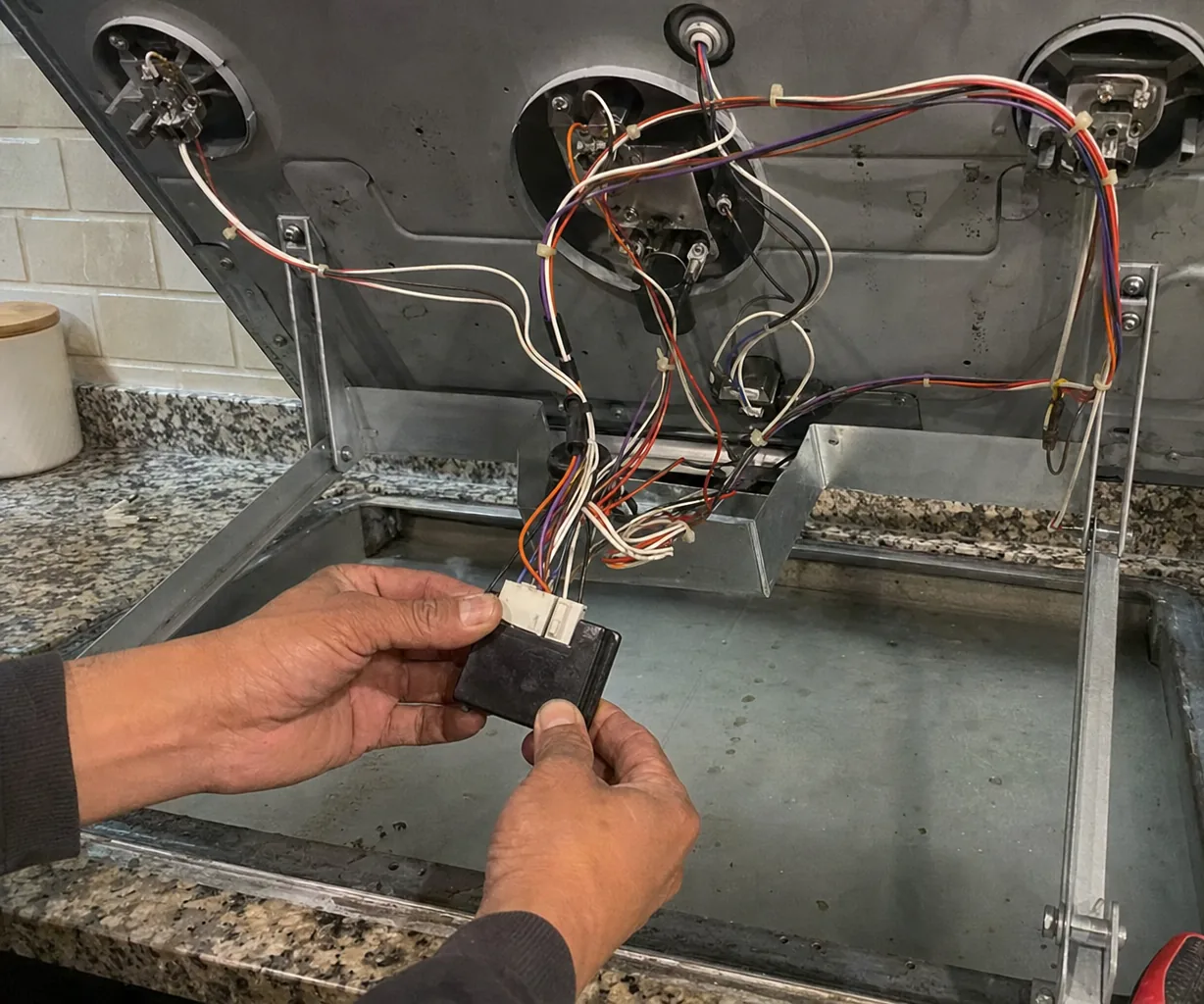
Half of what makes a built-in expensive to repair is how it was fitted. Clearance is checked before a part is ordered, not after.
Article
Why half a built-in repair is getting the machine out
The half of the job nobody quotes for
Most people picture an appliance repair as the moment the part goes in. On built-in equipment that moment is usually the shortest part of the visit. The long part is everything that has to happen before a technician can put a hand on the failed component at all, and almost none of it is visible from the front of the kitchen.
A freestanding range sits on the floor with a gas flex behind it and comes forward with two people and a floor protector. A built-in refrigerator, an undercounter wine cabinet or a dishwasher is a different proposition: it is fastened to the cabinetry, it shares a face with the millwork, and the connections that have to be broken are behind it, underneath it, or both.
That is why we look at the installation before we quote, and why two houses with the same fault on the same appliance can get honestly different estimates.
The order things come off in
There is a sequence, and it exists because doing it in any other order breaks something.
Power and fuel first. Nothing moves until the circuit is off and, on gas equipment, the shutoff at the appliance is closed. On a lot of installs the outlet behind the machine is the least accessible thing in the kitchen, which is precisely why the breaker gets used instead.
Then the trim and the fasteners. Built-ins are secured through the frame into the cabinet sides or up into the countertop substrate. Toe grilles, filler strips and decorative panels come off first, and every fastener gets kept in one place, because a missing screw at reassembly means the door will not sit square.
Then the plumbing. A refrigerator with an ice maker has a supply line behind it, and it is short. Pulling the appliance before that line is disconnected or verified as long enough is how a small repair becomes a water clean-up.
Then the machine, on its rails or on a protector. Only then.
Doors last, if at all. Removing a heavy door drops a lot of weight and makes the unit easier to handle, but door removal is also the step most likely to disturb a hinge or an alignment that was fine when we arrived. We do it when the access genuinely needs it, not by default.
Weight, rails and floors
Professional-grade equipment is built out of heavy-gauge steel with welded frames, and it is heavier than its domestic equivalent by a noticeable margin. A full-height built-in refrigerator, a 48 inch range or a stone-topped island section is a two-person move on principle, not on preference.
Where the manufacturer provided rails or rollers, the appliance is designed to come forward for exactly this reason and the move is quick. Where a previous installer removed them, shimmed the unit, or set it on a floor that has since been replaced with a thicker tile, it is not. We carry protection for hardwood, tile and stone floors and we use it on every call, because scratching a floor to save ten minutes is a bad trade for everybody.
Clearance the spec sheet asked for
Built-in refrigeration and ventilation both need a stated air gap around the cabinet. When a kitchen was built to those dimensions, the machine breathes, the condenser or the blower does its job, and service access is designed in.
Retrofits are where this goes wrong. An appliance dropped into an opening cut for something else may fit visually and still be short of the clearance the manufacturer asked for. Two things follow: the equipment runs hotter and harder than it should for its whole life, and there is no room to get a hand or a tool past it when something fails.
If we find that, we will tell you plainly. It is not a criticism of your kitchen; it is a fact that changes what a repair costs and how long the appliance will last afterwards.
What we check before anything moves
The walk-up takes a few minutes and saves hours. We look at how the appliance is fixed, whether the opening is a standard module or a hand-built enclosure, what the countertop does at the front edge, where the shutoff and the outlet are, what the floor is, and whether the unit has ever been out since it went in.
From that we can tell you, before work starts, whether this is a single visit or two, whether a cabinet fitter needs to be involved, and whether the part is worth fitting to this installation at all.
Why it goes in the written estimate
Access work is real work and it belongs on the quote in words, not as a surprise line on the invoice. Where a countertop overhang, a fixed panel or a gas connection has to be dealt with before the failed part can be reached, that is stated up front, and you decide with the whole number in front of you.
Questions
Follow-ups
Why does the estimate depend on how the appliance is installed?
Because the failed part is often reachable only from the back or the underside. A unit that rolls forward on its own rails is a different job from one boxed into a hand-built enclosure with a stone lip over the front edge, even when the part and the fault are identical.
Can I move the appliance out myself before you arrive?
Please do not. Professional equipment is heavy, the gas flex and the water line are behind it, and a hardwood or tile floor damages easily. Clear the cabinet fronts and the floor in front of the machine and leave the rest to us.
Price Bands
What does a repair cost, band by band?
Parts and labour together, in the bands these jobs land in. The $80 diagnostic comes off the bill when you approve the work, and the firm figure is written down after the fault is proved.
| Work | Typical range |
|---|---|
| Diagnostic visit | $80 |
| Refrigeration fan or defrost system | $240–$640 |
| Compressor or sealed-system repair | $980–$2,470 |
| Control board or touch panel | $390–$930 |
If This Is Your Problem
The appliances this affects
Built-in and freestanding refrigeration. Sealed-system faults, ice maker fill valves, defrost and fan faults, condenser corrosion on the coast, and door hardware.
Undercounter and full-height wine storage. Temperature stability, dual-zone faults, condenser airflow in tight cabinets, door seals, and sealed-system diagnosis.
Panel-ready and stainless dishwashers. Drain and fill faults, heater and relay failures, blocked spray arms, door spring and cable wear, and boards after power events.
Sealed burners, spark modules, oven temperature drift and the door hinges that carry a 40-pound door. 30, 36, 48 and 60 inch ranges, gas and dual fuel.
Where It Bites
Areas where this one matters most
These are the service-area pages that turn on this problem. Each one carries its own published figures rather than repeating this article.
Our dispatch base and the shortest drive we make. The housing along the SR-13 corridor is 1990s and 2000s, so most of the equipment here is now at the age where the electronics matter.
New construction throughout, so access is rarely the obstacle. What we get called for here is wear parts reaching their age, and control boards after power events.
Coastal, so salt takes condensers, hinge pins and fasteners. The housing spans four decades and most of the older kitchens have been remodelled twice, which decides the access.
Two different service problems in one city. Modern built-ins on the Southside, and 1900s to 1930s kitchens with undersized openings in Riverside, Avondale and Ortega.
Three service environments in one city. Modern openings at Palencia, salt corrosion on the coastal side, and a historic core with kitchens never laid out for modern equipment.
The building here is recent and the installs are sound, so access is rarely the constraint. Power events and tightly built houses account for most of what we are called out for.
Keep Reading
Next article
The three things that go wrong when a modern professional range meets a hundred-year-old kitchen: the opening is undersized, there is no dedicated 20A circuit, and the floor is no longer level.
Two appliances with the same model number can take different parts depending on when they were built. This is how we identify the right one, what we carry, what has to be ordered, and how long each of those honestly takes.
Customer Comments
What customers said afterwards
4.8 out of 5, across 90 customer reviews. Every one is a single visit, in the words of the person whose kitchen it happened in.
Ours held temperature but hummed loudly at night. He isolated the evaporator fan, found a bearing dry and the blade rubbing its shroud, and replaced the assembly. Quiet again, though it took a second trip for the part.
Water collected under the crisper drawers and froze into a sheet. He cleared a blocked drain line, warmed the tube through and fitted the clip that keeps it clear. Nothing has pooled since and no parts were sold to us.
Next Step
Book a diagnostic
Give us the model number and what it is doing. We quote in writing before anything comes apart.
- $80 diagnostic, credited
- 90-day labor
- 365-day parts
- Mon-Fri 8am-6pm. Sat 9am-4pm. Closed Sunday.