Water collected under the crisper drawers and froze into a sheet. He cleared a blocked drain line, warmed the tube through and fitted the clip that keeps it clear. Nothing has pooled since and no parts were sold to us.
Refrigeration
Viking refrigerator repair
Built-in and freestanding refrigeration. Sealed-system faults, ice maker fill valves, defrost and fan faults, condenser corrosion on the coast, and door hardware.
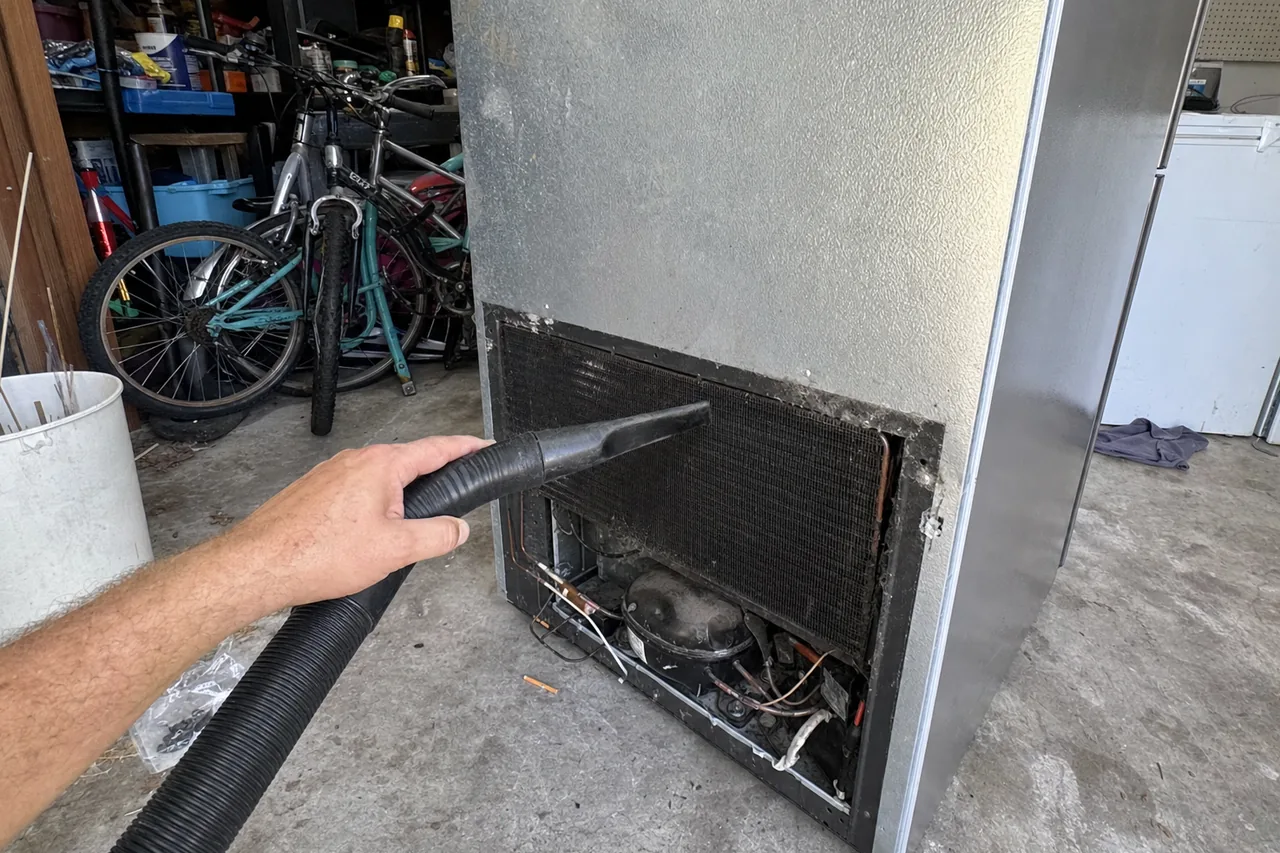
A coil that cannot shed heat looks exactly like a failing compressor from the kitchen side. The grille comes off before anything else is judged.
Symptoms
What you are seeing, and what it usually is
Described from the owner's side. No invented error codes. Where the cause is not certain, what gets checked is listed rather than guessed at.
| Observed | Usually | The work |
|---|---|---|
| Fresh food section warm, freezer still cold | Evaporator fan, damper or defrost fault rather than a sealed-system failure. On a single-evaporator design the fresh food side is fed from the freezer, so it fails first. | Check the fan, the damper travel and the defrost cycle before touching refrigerant. |
| Both compartments slowly warming, compressor running constantly | Restriction or a refrigerant loss in the sealed system, or a condenser so blocked it cannot reject heat. | Clean and inspect the condenser first. If the sealed system is genuinely at fault, opening it is EPA Section 608 work and we hold that certification. |
| Ice maker makes hollow, cloudy or shrinking cubes | The fill valve is no longer metering a full charge, so the mould never fills properly. It is the most common refrigeration call we run. | Measure fill volume and freeze time, inspect the mould and the fill tube, and replace the valve where the metering has drifted. |
| Ice maker stopped completely | Frozen fill tube, failed fill valve, or a mould heater that has given up. Cold water lines in the door are the usual suspects. | Thaw and inspect the tube, test the valve at the terminals, check the mould heater resistance. |
| Rust or white bloom on the condenser and hinges | Salt-air corrosion. Standard in the coastal ZIPs and it eats fasteners, hinge pins and fin stock. | Clean the coil properly, treat and replace corroded hardware, and set a coil cleaning interval that suits a coastal house. |
| Door not closing on its own or dropping at the front | Hinge cam or closer wear. A built-in door with a full-height panel on it is heavy, and the closer carries that weight every day. | Replace the cam or closer, reset the door height, verify the gasket seals at all four corners. |
| Water pooling under the crisper | Blocked defrost drain, sometimes with a crust of deposit in the drain trough holding the water back. | Clear the drain and trough, check the drain heater where one is fitted, confirm flow to the pan. |
Price Bands
What does a refrigeration repair cost?
Parts and labour together, in the bands these jobs land in. The $80 diagnostic comes off the bill when you approve the work, and the firm figure is written down after the fault is proved.
| Work | Typical range |
|---|---|
| Diagnostic visit | $80 |
| Refrigeration fan or defrost system | $240–$640 |
| Compressor or sealed-system repair | $980–$2,470 |
| Control board or touch panel | $390–$930 |
Detail
How we approach it
Two very different classes of fault
Refrigeration calls split cleanly. On one side, everything outside the sealed system: fans, dampers, defrost, boards, doors, ice makers. On the other, the sealed system — compressor, condenser, evaporator, metering device and the refrigerant charge inside them.
The first group is most of the work and most of it is same-visit. The second group needs recovery and charging equipment, EPA Section 608 certification, and usually a second visit. We do not open a sealed system on a hunch. We prove the fault first.
The ice maker is the part most likely to be replaced
The component we replace most often is the ice maker fill valve, because it does the hardest job in the machine: meter a small, repeatable volume of water on a solenoid that opens for a few seconds at a time, then hold it back for the rest of the cycle.
The sequence is predictable enough to recognise over the phone, which is why we ask. Cubes shrink, because the valve no longer passes a full fill. Then they come out hollow. Then the mould stops releasing cleanly. Then the fill tube freezes, because a slow seep past a tired seat cannot beat the freeze cycle and builds a plug.
What we do about it is measurable rather than approximate: time a fill, measure the volume that actually arrives, time the freeze cycle, and check the mould heater’s resistance before condemning anything. That order matters: a mould heater that has opened, a chafed harness at the door hinge, and a valve that no longer meters all produce the same complaint from the kitchen side, and only one of them is fixed by a valve.
The part of the job that is not the part
On a built-in, reaching the fill valve, the harness or the condenser means getting the appliance forward, and that step decides how long the visit takes. Intact rails and a standard opening make it quick. A shimmed unit, a hand-built enclosure, or a countertop with a stone lip over the front edge does not.
The installation is looked at before anything moves, and whether the job is one visit or two is said up front. Built-in refrigeration is a two-person move as a matter of course, and the supply line behind it is short, so it comes off before the machine travels.
Salt air
In 32082, 32250, 32233 and 32084, condensers corrode. Salt aerosol gets into the machine compartment and settles on the fin stock, the fasteners and the hinge pins. A corroded condenser rejects heat badly, so the compressor runs longer, which looks exactly like a refrigerant problem on a work order. We clean and inspect before we ever get the gauges out.
Doors on built-ins
A built-in door carrying a full-height custom panel is heavy, and the closer cam is the wear part. When it goes the door stops self-closing at the last inch, the gasket does not compress, and the compartment slowly warms. Owners describe it as a cooling fault. It is hardware, and cheap to fix if it is caught before the ice maker floods.
Before you call
Three things worth checking, because they occasionally save a visit and they always speed one up.
Pull the toe grille and look at the condenser. If you cannot see daylight between the fins, that is your first suspect and cleaning it is free.
Put a thermometer in a glass of water on the middle shelf overnight and read it in the morning. Every door opening skews a cabinet reading; a glass of water gives the real average, and it separates a two degree drift from a genuine cooling failure.
Listen at the machine compartment. A compressor that hums for a couple of seconds and cuts out is a start component, and that is an inexpensive part. A compressor running continuously points somewhere else entirely.
Terms
$80 flat diagnostic, credited to the repair. Written estimate first. 90 days labor, 365 days parts, genuine OEM parts. Independent shop.
Job Data
Scope and terms for this appliance
| Item | Detail |
|---|---|
| Types serviced | Built-in, freestanding, all-refrigerator and all-freezer |
| Sealed system | Yes, EPA Section 608 |
| Diagnostic | $80 |
| Labor warranty | 90 days |
| Parts warranty | 365 days |
| Sealed-system visits | Usually two |
EPA Section 608
Sealed-system work
Opening a sealed refrigeration system and handling refrigerant requires EPA Section 608 certification under federal law. Our refrigeration techs hold it — a federal credential, not a manufacturer certification of any kind.
A sealed-system fault gets proved before anything is opened. Condenser condition, airflow, fans, dampers, defrost and door seals are ruled out first: every one of them looks like a refrigerant problem on a work order.
Questions
Asked on most of these calls
What does EPA Section 608 actually mean?
It is the federal certification required to open a sealed refrigeration system and handle refrigerant. It is not a manufacturer certification and it is not optional. Our refrigeration techs hold it.
Is a sealed-system repair worth doing on a built-in?
Often yes, because a built-in is fitted to the cabinetry and replacing it means joinery as well as an appliance. We give you the sealed-system quote and the honest odds before you decide.
Why does my ice maker fail so much faster than my neighbour's?
Usage is the biggest single factor, and it is rarely equal. A house that empties the bin every day cycles the fill valve and the mould heater several times as often as one that does not, and both are wear parts. Water temperature at the inlet and how often the bin is left empty and running both add to it.
How much does it cost to replace a compressor?
Compressor and sealed-system work is the top band on this page, parts and labour together, and it is several times any other refrigeration repair. That is exactly why everything cheaper is ruled out first. On a built-in it is still a fraction of replacement, and the repair-or-replace page shows that division.
You do refrigeration. Is that the same as air conditioning?
No. The only thing we are asked to cool is the inside of a cabinet. EPA Section 608 is a federal certification to open a sealed refrigeration system and handle refrigerant, and our techs hold it, but that is appliance work. Heat pumps, air handlers and anything that conditions a room are an HVAC contractor's trade, not ours.
Related Appliances
Often the same call
$80 flat diagnostic, credited toward the repair. The diagnostic covers the visit, not the machine, so say so when you book if two are down.
Undercounter and full-height wine storage. Temperature stability, dual-zone faults, condenser airflow in tight cabinets, door seals, and sealed-system diagnosis.
Panel-ready and stainless dishwashers. Drain and fill faults, heater and relay failures, blocked spray arms, door spring and cable wear, and boards after power events.
Built-in and cart grills. Burner burn-through, igniter and valve failure, rotisserie motors, and the corrosion that coastal salt air puts into every fastener.
Where This Comes Up
Areas where we see this most
Ranked by how far this appliance's failure pattern overlaps the housing stock, the exposure and the equipment age there. 40 miles by road of Fruit Cove, St. Johns County.
Reading
Background on this fault
Customer Comments
What customers said after a refrigeration visit
4.8 out of 5, across 90 customer reviews. Every one is a single visit, in the words of the person whose kitchen it happened in.
The evaporator fan screeched every time the door shut. He showed us the worn bearing before he replaced it, then checked airflow through both compartments once the cabinet had run for a while.
Ice built up on the back wall of the freezer every few weeks. He tested the defrost heater and the bimetal, found the bimetal open and replaced it. He explained why the board was not the problem, which saved us a lot.
Next Step
Book a diagnostic
Give us the model number and what it is doing. We quote in writing before anything comes apart.
- $80 diagnostic, credited
- 90-day labor
- 365-day parts
- Mon-Fri 8am-6pm. Sat 9am-4pm. Closed Sunday.