Ours ran constantly and the kitchen floor beside it was warm. He pulled the lower panel, showed me the condenser matted with dust and pet hair, cleaned it and then rechecked the running current before leaving.
Coastal corrosion
What salt air does to a condenser
Salt aerosol packs condenser fin stock, seizes fasteners and eats hinge pins. The symptoms mimic a refrigerant fault, which is how coastal owners end up quoted for sealed-system work they do not need.
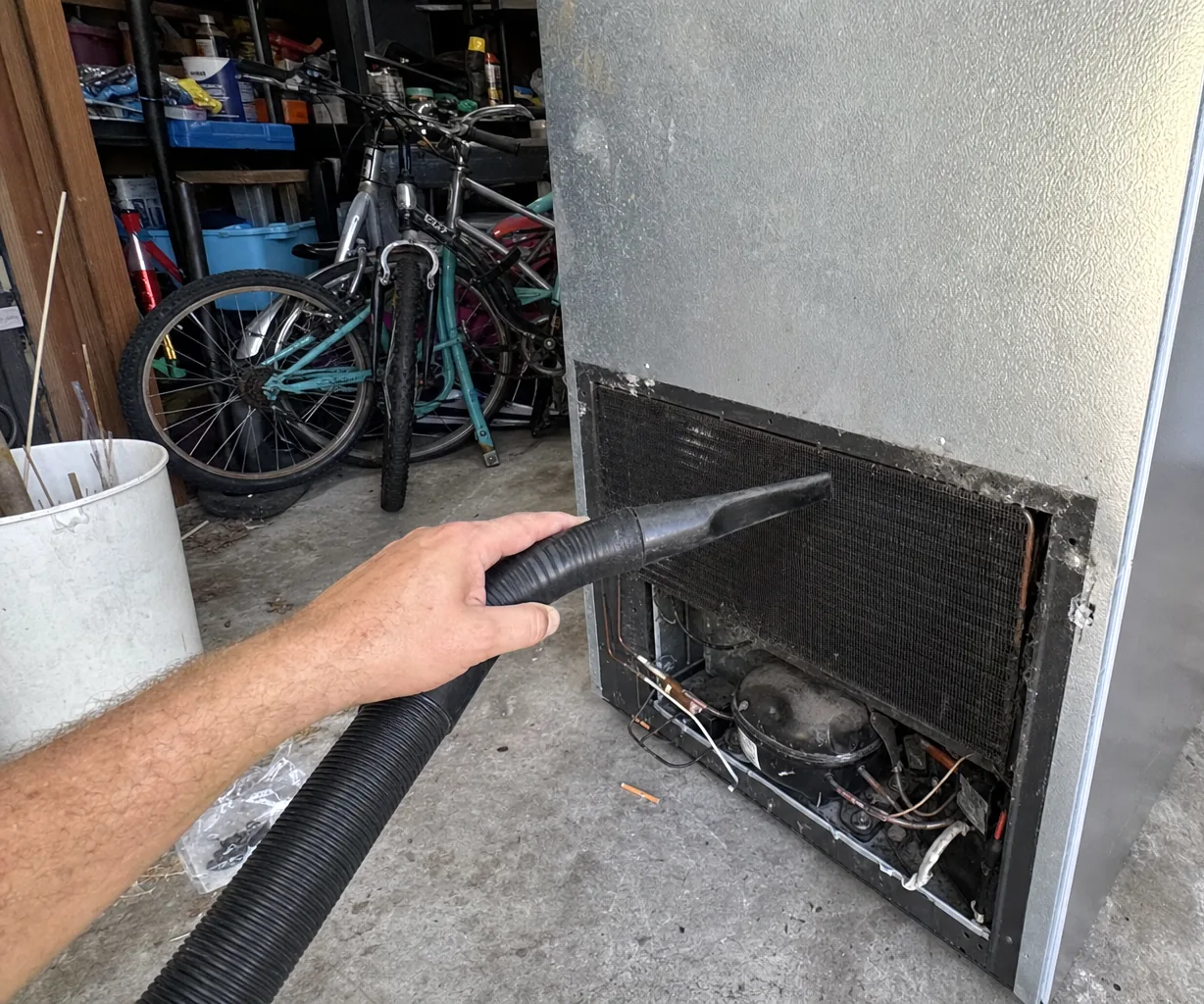
Near the water that grey mat on the fins is corrosion product, not dust. It insulates the coil and it returns faster than dust does.
Article
What salt air does to a condenser
Why coastal refrigeration gets misdiagnosed
A refrigerator rejects the heat it removes from the cabinet through a condenser: aluminium fin stock over copper tubing, with a fan pulling room air across it. It is a heat exchanger and it is also, unavoidably, an air filter.
Near the ocean, that air carries salt aerosol. The salt settles on the fins and corrodes the aluminium. The corrosion product is bulkier than the metal it came from, so it packs the gaps between the fins. Airflow falls. The condenser can no longer dump heat at the rate the system was designed around.
Now look at the symptoms. Compressor runs continuously. Cabinet drifts warm on a hot afternoon. Discharge temperature high. Head pressure high. Every one of those is also a symptom of a refrigerant restriction or an undercharge, which is why the wrong answer gets given so often. A technician who arrives, sees a compressor running non-stop and puts gauges on the machine will find readings that support the expensive diagnosis.
In a house in 32082, 32250, 32266, 32233 or 32084, the first move is to clean the condenser properly and re-measure. Not blow it out with a can of air. Clean it, fin by fin, and inspect the fin stock for actual metal loss. A meaningful number of quoted sealed-system jobs at the beach turn into a coil clean.
What else salt takes
Hinge pins and door closers. A built-in refrigerator door with a full-height cabinet panel on it is heavy, and the closer cam does that work every day. Corrosion at the pin adds friction, the door stops self-closing at the final inch, the gasket never compresses, and the compartment slowly warms. That is another cooling complaint with a hardware cause.
Outdoor grill manifolds. Valve stems are the most exposed moving parts on any coastal appliance. Salt and grease combine into something that sets like soft cement. The first sign is a knob that needs two hands. The second is a knob that shears off. Cycling every knob through its full travel once a month, in season or out, prevents most of these calls and costs nothing.
Hood blower dampers. Remote and roof-mounted blowers have a damper that opens under airflow. Salt seizes the hinge. The blower runs, the damper does not open fully, and the hood loses its top speed. Owners assume the motor is tired. It very often is not.
Every fastener. On a coastal call we expect at least one seized screw. That is not a complaint about the appliance, it is scheduling. We carry the extraction kit as standard.
A maintenance routine that actually works
Within about a mile of the ocean, clean condensers twice a year. Further back, once a year. This is the highest-value maintenance job on a coastal appliance and almost nobody does it.
Rinse outdoor equipment with fresh water after any wind-driven salt event. Use a breathable cover on a cold grill, never a sealed one, because a sealed cover traps humidity against the steel and does more harm than the salt.
Cycle grill valves monthly. Open and close built-in refrigerator doors fully and watch whether they still self-close at the last inch. If they do not, get the closer looked at before the cabinet temperature starts drifting.
What we will not tell you about your own house
Salt exposure falls off with distance from the water, but it is not a line on a map. It varies with the prevailing wind, with how open the lot is, with whether the machine compartment draws air from a garage or from the kitchen, and with how often anybody has cleaned the condenser. Two houses on the same street can be in genuinely different condition after ten years.
So we do not publish a corrosion schedule and tell you it applies to your address. What we do is look at the actual fin stock, the actual fasteners and the actual hinge pins on the first visit, and give you an interval based on what is in front of us. That reading stays useful for years and it is worth more than any general rule about coastal living.
If the condenser turns out to be clean and the fasteners turn out to be sound, we will say that too, and go and look somewhere else for your fault.
Questions
Follow-ups
How far inland does salt air reach?
Concentration falls off sharply with distance from the water, but it is not a hard line. We see meaningful corrosion several miles back, and we see far more of it within a mile of the ocean.
Can a corroded condenser be cleaned rather than replaced?
Usually yes, if it is caught while the corrosion is surface deposit packing the fins rather than fin stock that has actually crumbled. That is why twice-yearly cleaning matters in a beach house.
Price Bands
What does a repair cost, band by band?
Parts and labour together, in the bands these jobs land in. The $80 diagnostic comes off the bill when you approve the work, and the firm figure is written down after the fault is proved.
| Work | Typical range |
|---|---|
| Diagnostic visit | $80 |
| Control board or touch panel | $390–$930 |
| Igniter or burner assembly | $200–$570 |
If This Is Your Problem
The appliances this affects
Built-in and freestanding refrigeration. Sealed-system faults, ice maker fill valves, defrost and fan faults, condenser corrosion on the coast, and door hardware.
Built-in and cart grills. Burner burn-through, igniter and valve failure, rotisserie motors, and the corrosion that coastal salt air puts into every fastener.
Wall, island and professional hoods with internal, inline or remote blowers. Motor and speed control faults, lighting, baffle and duct problems, make-up air diagnosis.
Undercounter and full-height wine storage. Temperature stability, dual-zone faults, condenser airflow in tight cabinets, door seals, and sealed-system diagnosis.
Where It Bites
Areas where this one matters most
These are the service-area pages that turn on this problem. Each one carries its own published figures rather than repeating this article.
Coastal, so salt takes condensers, hinge pins and fasteners. The housing spans four decades and most of the older kitchens have been remodelled twice, which decides the access.
Three service environments in one city. Modern openings at Palencia, salt corrosion on the coastal side, and a historic core with kitchens never laid out for modern equipment.
Corrosion territory. Salt aerosol takes condensers, hinge pins and fasteners here, and the older beach houses put appliances in enclosures that were built around them.
Keep Reading
Next article
Cabinet openings, countertop overhangs, rails, weight and the connections at the back decide how long a built-in repair takes. None of it is visible from the front, which is why we look at the installation before quoting.
Surge damage is rarely instant. A board takes a hit, keeps working, and fails days later. Understanding that changes what a technician should test first and what protection is worth buying.
Customer Comments
What customers said afterwards
4.8 out of 5, across 90 customer reviews. Every one is a single visit, in the words of the person whose kitchen it happened in.
Ice built up on the back wall of the freezer every few weeks. He tested the defrost heater and the bimetal, found the bimetal open and replaced it. He explained why the board was not the problem, which saved us a lot.
Water collected under the crisper drawers and froze into a sheet. He cleared a blocked drain line, warmed the tube through and fitted the clip that keeps it clear. Nothing has pooled since and no parts were sold to us.
Next Step
Book a diagnostic
Give us the model number and what it is doing. We quote in writing before anything comes apart.
- $80 diagnostic, credited
- 90-day labor
- 365-day parts
- Mon-Fri 8am-6pm. Sat 9am-4pm. Closed Sunday.