The cabinet was running several degrees warm in the lower zone. He cleaned the condenser, checked both evaporator fans and replaced the one that had stalled. It has held steady since.
Duval County
The Beaches: salt air, and kitchens built around the appliance
Corrosion territory. Salt aerosol takes condensers, hinge pins and fasteners here, and the older beach houses put appliances in enclosures that were built around them.
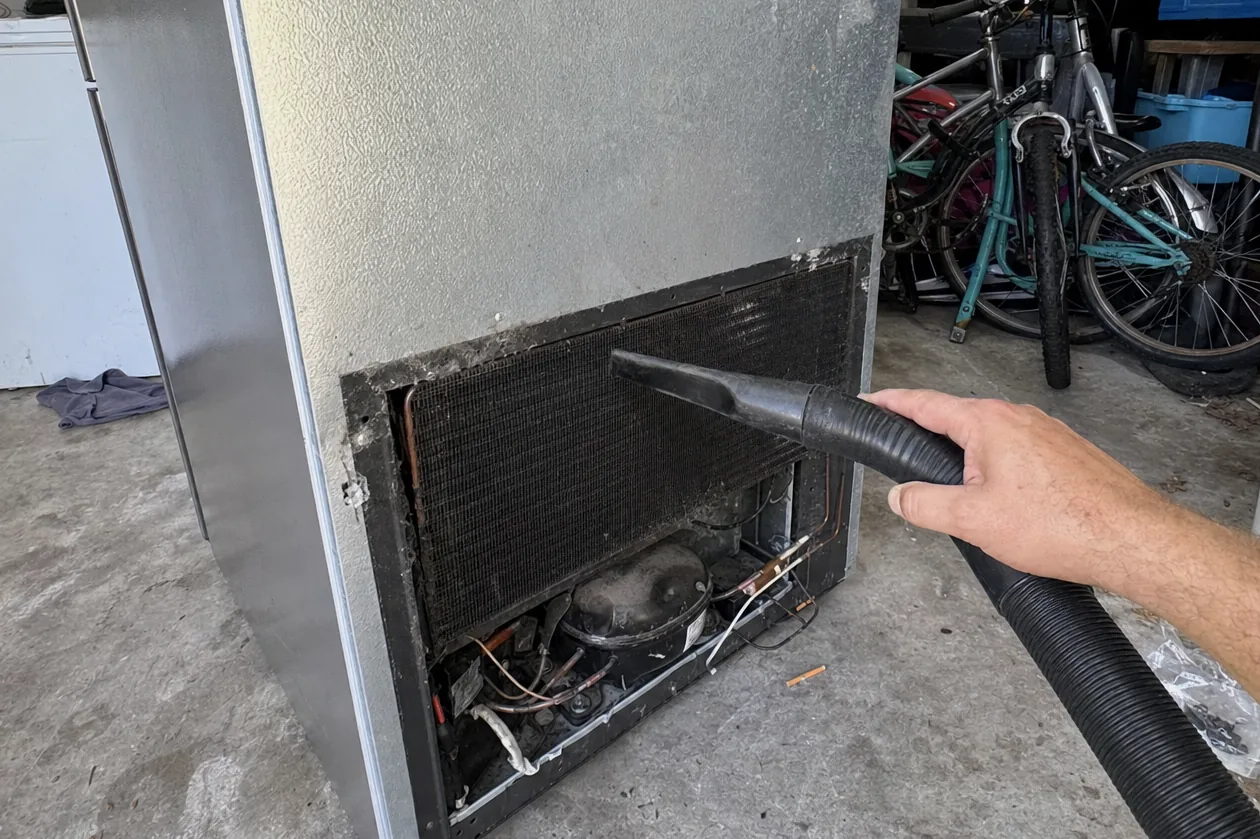
A block from the Atlantic, condensers and hardware corrode on a schedule that has nothing to do with how old the appliance is.
On Arrival
What the van meets at this address
Most of the time lost on a built-in call goes before a tool comes out, getting the machine far enough forward to reach the back of it. That varies by build era more than by appliance, so this is what we expect in Jacksonville Beach.
| Factor | What it means on the day |
|---|---|
| Build era | A wide range, from small pre-war beach houses to recent oceanfront rebuilds, often on the same street. |
| Enclosures built afterwards | In the older stock, appliances are frequently sitting in enclosures built around them after installation, so the way out has to be worked out on the day rather than assumed. |
| Salt exposure | Highest of anywhere we cover. Condensers, hinge pins, closer cams, grill manifolds and every fastener are all affected, and they are affected continuously. |
| Seized hardware | We expect at least one seized fastener on every coastal call and carry the extraction kit as standard. Forcing a corroded valve stem shears it. |
| Distance and batching | 30 miles and about 45 minutes by road. We batch beach calls onto the same day where we can, and load wider for them. |
Local Notes
What this place does to appliances
The corrosion mechanism
Salt aerosol carries inland on the wind and settles on every surface that air moves across. In an appliance, the surface that moves the most air is the condenser: an aluminium and copper heat exchanger with a fan pulling room air through it continuously.
Salt on aluminium fin stock corrodes it, and the corrosion product packs the gaps between the fins. Airflow drops. The condenser can no longer reject heat, so the compressor runs longer and longer to hold the same cabinet temperature. On a hot August afternoon it stops holding at all.
Every symptom of that reads as a sealed-system failure. The compressor runs constantly. The cabinet drifts warm. Discharge temperature is high. A technician in a hurry gets the gauges out and quotes a sealed-system repair. In a coastal house, the first move is always to clean and inspect the condenser properly and re-measure. We have turned a lot of quoted sealed-system jobs into a coil clean out here.
Everything else salt attacks
Hinge pins and door closer cams on built-in refrigeration. Once a cam is corroded the door stops self-closing at the last inch, the gasket does not compress, and the compartment warms.
Outdoor grill manifolds. Valve stems seize, and once a stem is seized, forcing the knob shears it. Cycling every knob monthly, in season or out, prevents almost all of these calls.
Remote and roof-mounted hood blowers. Damper hinges seize shut and motor housings corrode from the outside in. A hood that has lost its top speed in a beach house very often has a damper that no longer opens, not a tired motor.
Fasteners. All of them. We expect at least one seized fastener on every coastal call and we carry the extraction kit as standard. That is not a complaint, it is scheduling.
The houses, and the way out
The Beaches run from small pre-war beach houses to recent oceanfront rebuilds, sometimes on the same street. In the older stock, kitchens are tight and appliances are frequently sitting in enclosures that were built around them after installation.
That changes the order of the job rather than its difficulty. Power off at the breaker first, because on these installs the outlet behind the machine is usually the least reachable thing in the room, and the gas shutoff closed before that on anything fuelled. Trim, filler strips and toe grilles off next, with the fasteners kept together, since a screw missing at reassembly leaves a door that will not sit square. Any water line disconnected before the appliance travels rather than after — the line behind a retrofitted refrigerator is often exactly long enough and no longer. Then floor protection, then two people.
Doors come off only when the access genuinely needs the weight reduced, because removing a heavy door is also the step most likely to disturb an alignment that was fine when we arrived.
We look at the install before we start and tell you what is involved, including the times when the honest answer is that a cabinet fitter needs to be part of the plan.
Maintenance that is genuinely worth doing
Three things, and we would rather you did them than called us.
Clean the condenser twice a year within about a mile of the ocean. It is the highest-value maintenance job on any coastal refrigeration and almost nobody does it.
Rinse outdoor equipment with fresh water after any wind-driven salt event, and use a breathable cover on a cold grill rather than a sealed one, which traps humidity against the steel and does more harm than the salt would have.
Cycle grill valves monthly and watch whether built-in doors still self-close over the last inch. Both are thirty-second checks that prevent expensive calls.
Terms and travel
30 miles and about 45 minutes by road from our base in Fruit Cove, inside the 40 mile radius we work. We batch beach calls onto the same day where we can. $80 flat diagnostic, credited toward the repair. Written estimate before work. 90 days on labor, 365 days on parts, genuine OEM parts. Sealed-system work is EPA Section 608 certified. Independent shop.
Trade Limits
Kitchen appliances in Jacksonville Beach. Not heating, not air conditioning.
Built-in kitchen appliances, one manufacturer. That is the entire list. Everything under the second heading is another trade, and we would rather say so here than send a van to an address we cannot help.
On the van
Not on the van
- Heating. Furnaces, heat pumps, air handlers, thermostats. No brand, no exceptions. We do not carry the parts and it is not the trade this shop is set up for.
- Air conditioning. Nothing that conditions a room. The only thing we are asked to cool is the inside of a cabinet, and only on this manufacturer’s refrigeration.
- House ductwork. We work the duct run behind a range hood, because the hood is a kitchen appliance and the run decides whether it pulls. Ducting that carries heated or cooled air through the house belongs to an HVAC contractor.
- Water heaters. Tank or tankless, gas or electric. A plumber’s job. We check the water a dishwasher is given and stop at the shut-off.
- Laundry. No washers, no dryers, ventilated or heat pump. They are not in this manufacturer’s kitchen line and they are not on the van.
- Other makes. One manufacturer. If the badge does not say Viking, we will tell you on the phone instead of charging a diagnostic to find out.
Which Viking this is
Viking on this site is the appliance manufacturer — the company that put commercial-style construction into a home kitchen and started the residential professional range. It is a badge on a range, an oven, a refrigerator or a hood.
It is not Viking, Florida, the community in Indian River County roughly 200 miles south of here. The two share a name and nothing else, and the mix-up sends heating and air-conditioning searches to pages like this one. This is a kitchen appliance shop working out of Fruit Cove on the First Coast. Heating and air conditioning are not work we take, here or anywhere.
The eight machines above are the whole of it. What we service lists the symptoms for each one, and the questions page answers the rest before you spend anything.
Housing Stock
The buildings, and why they matter on the day
A wide age range, from small pre-war beach houses to recent oceanfront rebuilds. Older kitchens are often tight, and a lot of appliances here sit in enclosures that were built around them.
Price Bands
What does an appliance repair cost in Jacksonville Beach?
Parts and labour together, in the bands these jobs land in. The $80 diagnostic comes off the bill when you approve the work, and the firm figure is written down after the fault is proved.
| Work | Typical range |
|---|---|
| Diagnostic visit | $80 |
| Igniter or burner assembly | $200–$570 |
| Oven thermostat or heating element | $190–$550 |
| Control board or touch panel | $390–$930 |
| Refrigeration fan or defrost system | $240–$640 |
The Visit
Travel and terms for Jacksonville Beach
| Item | Detail |
|---|---|
| Drive from base | 30 miles / about 45 minutes |
| County | Duval County |
| ZIPs covered | 32250, 32266, 32233 |
| Coastal exposure | Yes — salt corrosion expected |
| Diagnostic | $80 |
| Warranty | 90 days labor / 365 days parts |
| Hours | Mon-Fri 8am-6pm. Sat 9am-4pm. Closed Sunday. |
Questions
Asked locally
How often should a coastal condenser be cleaned?
Twice a year within a mile or so of the ocean, once a year further back. It is the single most cost-effective thing you can do for refrigeration in a beach house.
My grill hardware is seized solid after four summers. Is that normal?
At the beach, yes. Salt aerosol settles on manifolds, valve stems and fasteners. Cycling every knob through its full travel once a month, even out of season, prevents most of it.
The kitchen was built around the appliance. Can it still be repaired?
Almost always, but the access has to be planned rather than assumed. We look at how the unit is fixed, what the countertop does at the front edge and where the connections are before anything moves, and we tell you in the written estimate if a panel or a cabinet has to come off first.
Appliances
What we get called out for here
Ranked by how closely each appliance's failure pattern matches the housing stock, the exposure and the equipment age here — not by what we would like to sell.
Undercounter and full-height wine storage. Temperature stability, dual-zone faults, condenser airflow in tight cabinets, door seals, and sealed-system diagnosis.
Sealed burners, spark modules, oven temperature drift and the door hinges that carry a 40-pound door. 30, 36, 48 and 60 inch ranges, gas and dual fuel.
Single, double and combination wall ovens. Temperature drift, element and sensor faults, hinge and gasket wear, and control boards killed by power events.
Built-in and freestanding refrigeration. Sealed-system faults, ice maker fill valves, defrost and fan faults, condenser corrosion on the coast, and door hardware.
Customer Comments
What customers in Jacksonville Beach said afterwards
4.8 out of 5, across 90 customer reviews. Every one is a single visit, in the words of the person whose kitchen it happened in.
A door alarm sounded at odd hours with everything shut. He found the salt air had eaten into the reed switch contact near the hinge, sealed the entry and fitted a new switch. Silent since, and he explained the corrosion.
Convection roasting browned everything down the right side. He measured cavity temperature at four corners, found the fan motor slowing under heat and replaced it. A whole tray of vegetables now cooks evenly.
Next Step
Book a diagnostic
Give us the model number and what it is doing. We quote in writing before anything comes apart.
- $80 diagnostic, credited
- 90-day labor
- 365-day parts
- Mon-Fri 8am-6pm. Sat 9am-4pm. Closed Sunday.