Our built-in was tripping the breaker partway through a clean cycle. He found a door lock motor drawing far too much current, replaced it, and checked the circuit at the outlet before he left.
Wall ovens
Viking wall oven repair
Single, double and combination wall ovens. Temperature drift, element and sensor faults, hinge and gasket wear, and control boards killed by power events.
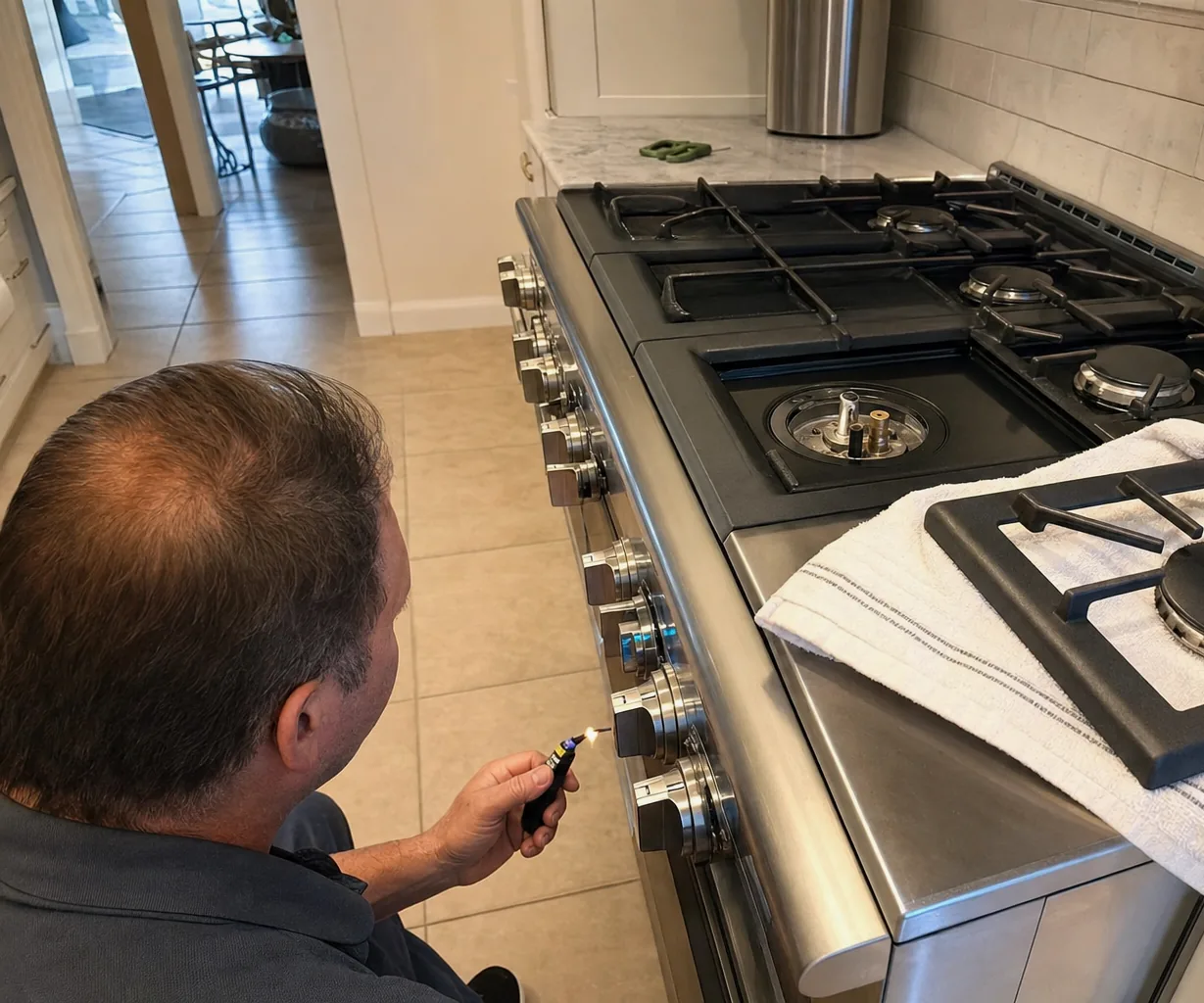
A wall oven fails in three places — heat, door, control. Each is measurable, so none of them is guessed at.
Symptoms
What you are seeing, and what it usually is
Described from the owner's side. No invented error codes. Where the cause is not certain, what gets checked is listed rather than guessed at.
| Observed | Usually | The work |
|---|---|---|
| Oven takes far longer to preheat than it used to | One element working instead of two, a drifted sensor, or a door that no longer seals at the top. | Check element draw on both bake and broil, read sensor resistance, pressure-test the gasket line with a strip of paper. |
| Food burns on top and stays pale underneath | Bake element open circuit, so the oven is holding temperature on the broil element alone. | Measure resistance across the bake element cold, inspect for a blown section, replace. |
| Oven turns on but never gets hot | An open bake element or a failed board relay on an electric cavity. On a gas cavity, an igniter drawing too little current to open the safety valve. | Measure element resistance and igniter current draw, check the relay and the sensor circuit, fit the failed part, then log a full cycle before leaving. |
| Display dead or frozen, oven unresponsive | Control board failure, often days after a storm rather than during one. | Confirm supply voltage and the low-voltage rail, inspect the board for burnt traces, replace and advise on surge protection. |
| Door will not close flush at one corner | One hinge has settled ahead of the other. Wall oven doors are heavy and the hinge does the work. | Replace hinges in pairs, reset the door square, verify the gasket contacts all the way round. |
| Self-clean cycle ran and now the oven is dead | Thermal fuse or thermal limit tripped, sometimes with collateral damage to the board. Self-clean drives the cavity far above cooking temperature and it finds every weak component. | Test the fuse and limit, check the board, and talk honestly about whether self-clean is worth running on an older oven. |
| Steam or combination oven throwing water faults | Deposit in the water circuit, a level sensor reading wrongly, or a pump that is no longer priming reliably. | Flush and clear the circuit, test the pump and the level sensor, and set a realistic service interval for how the oven is actually used. |
Price Bands
What does a wall ovens repair cost?
Parts and labour together, in the bands these jobs land in. The $80 diagnostic comes off the bill when you approve the work, and the firm figure is written down after the fault is proved.
| Work | Typical range |
|---|---|
| Diagnostic visit | $80 |
| Control board or touch panel | $390–$930 |
| Oven thermostat or heating element | $190–$550 |
Detail
How we approach it
Built in, which changes everything
A wall oven is the same cooking machine as the oven in a range, mounted in a cabinet. Every mechanical part is comparable. What is different is access, weight and the cabinet it lives in.
Getting a single wall oven out of a cabinet is a controlled job. Getting a double out is a two-person job with the trim, the anti-tip screws and often a granite lip in the way. We plan for it. If the fault can be fixed from the front we do not pull the oven at all.
Temperature is the number one call
Almost every wall oven complaint starts as “it is not cooking right”. That splits into four measurable cases and we separate them before quoting.
- The oven reads correctly and holds correctly, but bakes differently to the old one. Nothing is broken. Convection and radiant behave differently and a new gasket seals better.
- The oven is uniformly low or high. Usually a sensor whose resistance curve has drifted. A standard platinum resistance sensor sits near 1,080 ohms at room temperature; a long way off that and the control is being lied to.
- The oven overshoots on the way up and sags at the end. More often an element or gas valve problem than a sensor problem.
- The oven loses heat over a long bake. Door seal. Put a strip of paper in the door at four points around the frame and see where it pulls out with no resistance.
Doors and hinges
Wall oven doors are heavy glass sandwiches on spring-loaded hinges. The hinges do not fail suddenly; they settle. The first sign is a corner that no longer sits flush, and the second is a hot patch on the cabinet trim above the door. Once a hinge has settled, the door is out of square and the gasket cannot seal. We change hinges as a pair every time. Replacing one twists the door.
Control boards and the storm season
Roughly 68 thunderstorm days a year in this metro. Boards fail after power events, and the failure often shows up days later rather than at the moment of the strike. If your oven went dead in the week after a bad afternoon storm, we start at the board and the supply and work back.
Steam and combination ovens
A steam or combination oven has a plumbed or reservoir-fed water circuit, a pump, a level sensor and a boiling element, and every one of those is a part that a plain oven does not have. That is why the fault list is longer and why the diagnosis has to be ordered rather than guessed at.
The order we work it is supply, then sensing, then heat. Is water actually reaching the circuit and is the reservoir seated properly. Is the level sensor reading what is really in there, because a sensor that reads full when the circuit is empty produces a fault that looks like a dead pump. Then the pump and the element, which are the parts people assume first and which are genuinely third in line.
The circuit also needs clearing periodically rather than only when a fault appears, and the interval that matters is the one that suits how often you actually use the steam function — not the one printed for an oven that gets used twice a year.
Getting a wall oven out
A wall oven is the least forgiving appliance in the kitchen to remove: chest height, heavy, and carrying its own weight on a cabinet built around it. It is fastened through the frame into the cabinet sides, the connection is behind it, and a double is heavier again.
It comes out onto a stand at the same height, never onto the floor, and it is a two-person job every time. Where the opening was built for an earlier appliance and filler strips went in, that is dealt with before anything moves. All of it is checked before we quote: it changes the visit more than the part does.
Double ovens age unevenly
On a double wall oven the lower cavity usually does the bulk of the work, and it wears first. The upper cavity often has a sensor and elements in far better condition than the pair below it.
That matters when we quote. If the lower oven needs a sensor and an element and the upper is fine, you are not obliged to replace both, whatever a maintenance schedule says. It also means a fault that appears in one cavity and not the other tells us something immediately: the shared parts, meaning the supply, the main board and the door switch circuit, are probably healthy.
Terms
$80 flat diagnostic, credited toward the repair. Written estimate before any work. 90 days labor, 365 days parts, genuine OEM. Independent shop, no manufacturer contract.
Job Data
Scope and terms for this appliance
| Item | Detail |
|---|---|
| Types serviced | Single, double and combination steam |
| Widths | 27 and 30 inch |
| Diagnostic | $80 |
| Labor warranty | 90 days |
| Parts warranty | 365 days |
| Access | Oven must come out of the cabinet for most repairs |
Questions
Asked on most of these calls
Does the oven have to come out of the wall?
For a sensor, an element or a door, usually not. For a control board, a fan motor or wiring behind the cavity, yes. A double oven is a two-person lift and we schedule it that way.
Why does my oven read the right temperature but bake wrong?
Because the display shows what the control thinks, not what the cavity is doing. We log actual cavity temperature with an independent probe over three cycles before we call anything faulty.
My oven is working but not heating up. What is that?
The controls light and the fan runs, so supply is fine. What has failed is the heat itself or the circuit that calls for it. On an electric cavity that is usually the bake element or a relay on the board. On a gas cavity it is an igniter too weak to pull the safety valve open.
Should I still use self-clean?
On a newer oven it is fine. On an oven over about fifteen years old it is a real risk to the thermal fuse and the board. We will tell you which side of that line yours falls on.
Related Appliances
Often the same call
$80 flat diagnostic, credited toward the repair. The diagnostic covers the visit, not the machine, so say so when you book if two are down.
Sealed burners, spark modules, oven temperature drift and the door hinges that carry a 40-pound door. 30, 36, 48 and 60 inch ranges, gas and dual fuel.
Drop-in rangetops in 30, 36, 48 and 60 inch widths. Burner and valve work, simmer faults, griddle and grill module repair, and the counter cut-out problems nobody warned you about.
Wall, island and professional hoods with internal, inline or remote blowers. Motor and speed control faults, lighting, baffle and duct problems, make-up air diagnosis.
Where This Comes Up
Areas where we see this most
Ranked by how far this appliance's failure pattern overlaps the housing stock, the exposure and the equipment age there. 40 miles by road of Fruit Cove, St. Johns County.
Reading
Background on this fault
Customer Comments
What customers said after a wall ovens visit
4.8 out of 5, across 90 customer reviews. Every one is a single visit, in the words of the person whose kitchen it happened in.
The display had gone dim and half the touch panel ignored us. He found moisture had got behind the fascia from the steam of the cooktop below and had corroded the ribbon. Cleaned, resealed, new ribbon, working properly.
The oven took forever to preheat and never quite got there. He found the broil element open and the bake element weak, and was clear that replacing one without the other would just bring him back. Both done in one visit.
Next Step
Book a diagnostic
Give us the model number and what it is doing. We quote in writing before anything comes apart.
- $80 diagnostic, credited
- 90-day labor
- 365-day parts
- Mon-Fri 8am-6pm. Sat 9am-4pm. Closed Sunday.