Ours leaked at the lower corner and had marked the floor before we noticed. He replaced the door seal, dried and checked the base tray, and pointed out that the machine had never been levelled properly.
St. Johns County
World Golf Village: sound installs, and what still fails
The building here is recent and the installs are sound, so access is rarely the constraint. Power events and tightly built houses account for most of what we are called out for.
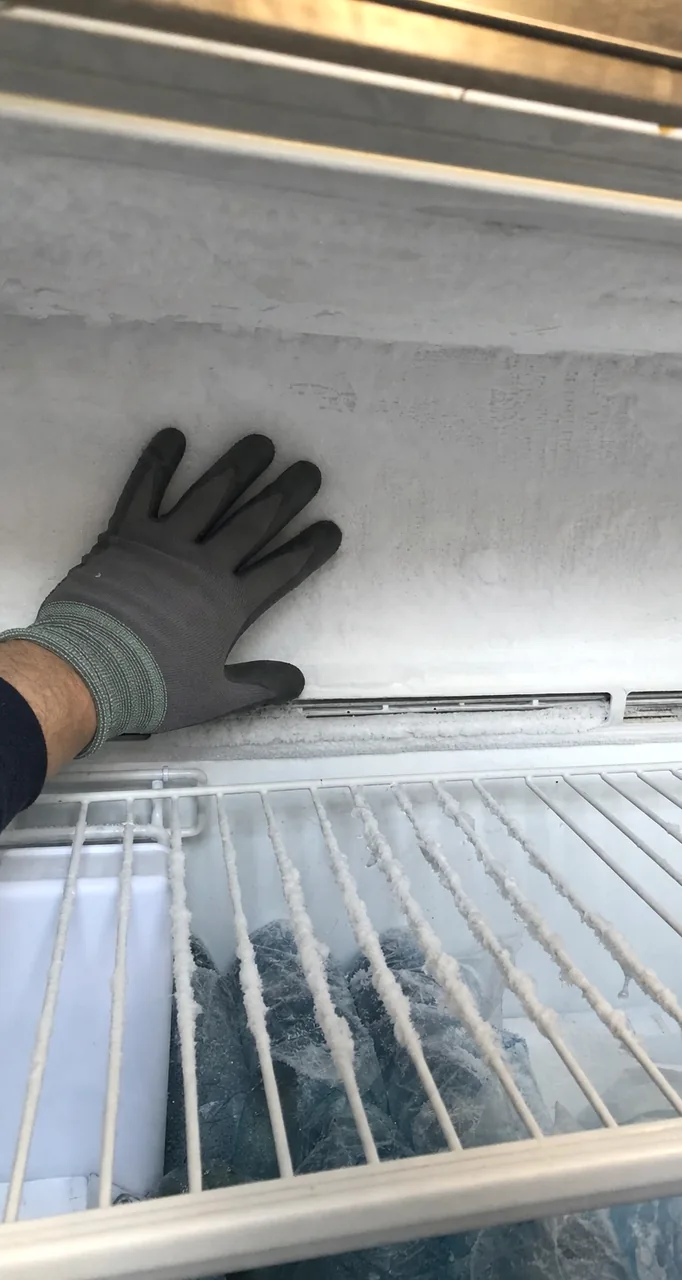
The houses out here are recent and the installs are sound, so a frosted wall like this one points at the appliance rather than at the way it was fitted.
On Arrival
What the van meets at this address
Most of the time lost on a built-in call goes before a tool comes out, getting the machine far enough forward to reach the back of it. That varies by build era more than by appliance, so this is what we expect in World Golf Village.
| Factor | What it means on the day |
|---|---|
| Build era | Recent building throughout, including King and Bear, Murabella, SilverLeaf and Shearwater. Standard openings, dedicated circuits and correctly sized gas runs. |
| Getting a built-in out | Access is rarely the constraint. Rails intact, level floors, and the ventilation clearance the spec sheet asked for actually present behind the cabinet. |
| Boards per kitchen | A recent kitchen is a kitchen full of control boards: range, oven, dishwasher, refrigeration, hood speed and wine cabinet. A panel-level surge device protects all of them at once. |
| Tight construction | Modern houses here leak very little air. Run a large hood on full and the kitchen goes slightly negative, which changes how burners and flues behave. |
| Distance | About 20 miles and 30 minutes by road from our base, mostly via CR-210 and I-95. |
Local Notes
What this place does to appliances
New houses, and what that removes from the diagnosis
The area around World Golf Village, running out along the SR-16 corridor through King and Bear, Murabella, SilverLeaf and Shearwater, is recent construction almost end to end.
That takes a whole category of problem off the table before we arrive. Cabinet openings are standard modules. Ranges come forward on level floors. Built-in refrigeration sits in enclosures that were built to the manufacturer’s dimensions with the ventilation clearance the spec sheet asked for. Kitchens have dedicated circuits and the gas runs are sized correctly. Nothing here has the difficulties we deal with in a 1920s Riverside kitchen.
Which means when something fails out here, the cause is narrow — and two things dominate.
Power events, in a kitchen full of boards
This metro sees roughly 68 thunderstorm days a year, and appliance control boards fail in the days following a rough afternoon rather than during it. That delay is why the connection so often gets missed: the storm was Tuesday, the range went dead on Saturday, and nobody puts the two together.
A recent kitchen makes the exposure worse rather than better, because a recent kitchen is full of boards. Range control, oven control, dishwasher control, refrigeration control, hood speed control, wine cabinet control. Every one of them is a model-and-serial specific part, which is exactly the category that cannot be carried on the van and has to be identified against your unit and ordered.
Two practical consequences. First, tell us when you book if the fault appeared during or shortly after a storm week — it changes what we test first and it often saves a second visit. Second, a surge device at the panel is a genuinely good investment here, and it is one we do not sell. It protects the whole kitchen for less than one board costs.
Tight houses, big hoods
The other pattern out here is a consequence of how well these houses are built.
A 48 or 60 inch professional cooktop under a matching canopy moves a lot of air. A modern, tightly constructed house has very little leakage. Run the hood on full and the kitchen goes slightly negative, and replacement air comes back in through whatever path is easiest.
Sometimes that is a door whistling. Sometimes it is a simmer flame lying over and going out. Occasionally it is a gas water heater flue back-draughting, which is a safety matter and we will tell you so on the spot and not touch anything else until it is addressed.
The diagnostic test is simple: does the fault only happen with the hood running, and only at its top speed. If so, it is an air supply problem, not a burner problem, and the fix is make-up air rather than parts. That is the sort of call where a flat diagnostic fee saves an owner a great deal of money.
Ventilation runs in newer builds
While we are on hoods: the duct run in a house this size is often long, and frequently ends in a remote or roof-mounted blower rather than an in-hood one. That changes the fault list.
One distinction is worth making here, because the searches that reach this page keep confusing it. The hood duct is a kitchen duct: it starts at the hood collar and ends at a roof or wall cap, and we work on all of it because the hood is a kitchen appliance. The ducting that carries heated or cooled air around a World Golf Village house is a different system in a different trade, and we do not touch it. Ironside does not install, repair or maintain heating or air conditioning of any kind.
A hood that has lost its top speed usually has a damper that no longer opens fully, not a tired motor. Long runs and multiple elbows cost static pressure, so a blower that was marginal on the day it was commissioned gets worse as the damper stiffens and the ducting picks up grease. We check the damper and the run before anybody quotes a motor.
What the good installs change about the estimate
When the kitchen was built correctly, more of the visit goes into the repair and less into reaching it. The labour line is shorter because the machine comes out and goes back without cabinet work, and the diagnosis is more certain because we can test at the connections behind the appliance rather than inferring from the front.
Terms and travel
20 miles, about 30 minutes by road from Fruit Cove. $80 flat diagnostic, credited to the repair. Written estimate before work starts. 90 days on labor, 365 days on parts, genuine OEM parts. Mon to Fri 8am to 6pm, Sat 9am to 4pm. Independent shop, no manufacturer contract.
Trade Limits
Kitchen appliances in World Golf Village. Not heating, not air conditioning.
Built-in kitchen appliances, one manufacturer. That is the entire list. Everything under the second heading is another trade, and we would rather say so here than send a van to an address we cannot help.
On the van
Not on the van
- Heating. Furnaces, heat pumps, air handlers, thermostats. No brand, no exceptions. We do not carry the parts and it is not the trade this shop is set up for.
- Air conditioning. Nothing that conditions a room. The only thing we are asked to cool is the inside of a cabinet, and only on this manufacturer’s refrigeration.
- House ductwork. We work the duct run behind a range hood, because the hood is a kitchen appliance and the run decides whether it pulls. Ducting that carries heated or cooled air through the house belongs to an HVAC contractor.
- Water heaters. Tank or tankless, gas or electric. A plumber’s job. We check the water a dishwasher is given and stop at the shut-off.
- Laundry. No washers, no dryers, ventilated or heat pump. They are not in this manufacturer’s kitchen line and they are not on the van.
- Other makes. One manufacturer. If the badge does not say Viking, we will tell you on the phone instead of charging a diagnostic to find out.
Which Viking this is
Viking on this site is the appliance manufacturer — the company that put commercial-style construction into a home kitchen and started the residential professional range. It is a badge on a range, an oven, a refrigerator or a hood.
It is not Viking, Florida, the community in Indian River County roughly 200 miles south of here. The two share a name and nothing else, and the mix-up sends heating and air-conditioning searches to pages like this one. This is a kitchen appliance shop working out of Fruit Cove on the First Coast. Heating and air conditioning are not work we take, here or anywhere.
The eight machines above are the whole of it. What we service lists the symptoms for each one, and the questions page answers the rest before you spend anything.
Housing Stock
The buildings, and why they matter on the day
Recent building throughout, including King and Bear, Murabella, SilverLeaf and Shearwater. Standard openings, dedicated circuits and correctly sized gas runs, so access is rarely the constraint.
Price Bands
What does an appliance repair cost in World Golf Village?
Parts and labour together, in the bands these jobs land in. The $80 diagnostic comes off the bill when you approve the work, and the firm figure is written down after the fault is proved.
| Work | Typical range |
|---|---|
| Diagnostic visit | $80 |
| Igniter or burner assembly | $200–$570 |
| Oven thermostat or heating element | $190–$550 |
| Control board or touch panel | $390–$930 |
| Refrigeration fan or defrost system | $240–$640 |
The Visit
Travel and terms for World Golf Village
| Item | Detail |
|---|---|
| Drive from base | 20 miles / about 30 minutes |
| County | St. Johns County |
| ZIPs covered | 32092 |
| Coastal exposure | No |
| Diagnostic | $80 |
| Warranty | 90 days labor / 365 days parts |
| Hours | Mon-Fri 8am-6pm. Sat 9am-4pm. Closed Sunday. |
Questions
Asked locally
Everything here is new. Why am I already calling somebody out?
Because new construction removes the installation problems, not the wear ones. Igniter electrodes foul, hinge springs settle, closers wear and fill valves drift out of metering on a schedule set by use rather than by the age of the house.
My simmer flame dies when the hood is on full. Is the burner faulty?
Usually not. A high-capacity hood in a tightly built modern house can pull the kitchen slightly negative and physically lift a low flame. If it only happens on the hood's top speed, that is an air problem and no part we could sell you would fix it.
How far out are you from World Golf Village?
About 20 miles and 30 minutes by road from our base in Fruit Cove, mostly via CR-210 and I-95.
Since you are already here, can you look at the heating or the AC?
No. We only do kitchen appliances. The ducting we open is the run behind a range hood and it stops at the roof or wall cap. The air handler, the heat pump and the ducting that conditions the rest of the house are an HVAC contractor's trade, and searching our name will keep turning up appliance pages because that is all we are.
Appliances
What we get called out for here
Ranked by how closely each appliance's failure pattern matches the housing stock, the exposure and the equipment age here — not by what we would like to sell.
Sealed burners, spark modules, oven temperature drift and the door hinges that carry a 40-pound door. 30, 36, 48 and 60 inch ranges, gas and dual fuel.
Panel-ready and stainless dishwashers. Drain and fill faults, heater and relay failures, blocked spray arms, door spring and cable wear, and boards after power events.
Single, double and combination wall ovens. Temperature drift, element and sensor faults, hinge and gasket wear, and control boards killed by power events.
Built-in and freestanding refrigeration. Sealed-system faults, ice maker fill valves, defrost and fan faults, condenser corrosion on the coast, and door hardware.
Customer Comments
What customers in World Golf Village said afterwards
4.8 out of 5, across 90 customer reviews. Every one is a single visit, in the words of the person whose kitchen it happened in.
Our built-in was tripping the breaker partway through a clean cycle. He found a door lock motor drawing far too much current, replaced it, and checked the circuit at the outlet before he left.
Smoke rolled out the front instead of going up the duct. He found the run crushed in the ceiling void and told me plainly that the real repair is builder work. He improved what he could reach and charged for what he did.
Next Step
Book a diagnostic
Give us the model number and what it is doing. We quote in writing before anything comes apart.
- $80 diagnostic, credited
- 90-day labor
- 365-day parts
- Mon-Fri 8am-6pm. Sat 9am-4pm. Closed Sunday.