Two of the sealed burners simmered unevenly and one would lift off the port. He pulled the caps, cleared the ports properly and reset the low-flame screws on the valves. Both hold a steady simmer now.
Parts and age
Why we ask for the serial number, not just the model
Two appliances with the same model number can take different parts depending on when they were built. This is how we identify the right one, what we carry, what has to be ordered, and how long each of those honestly takes.
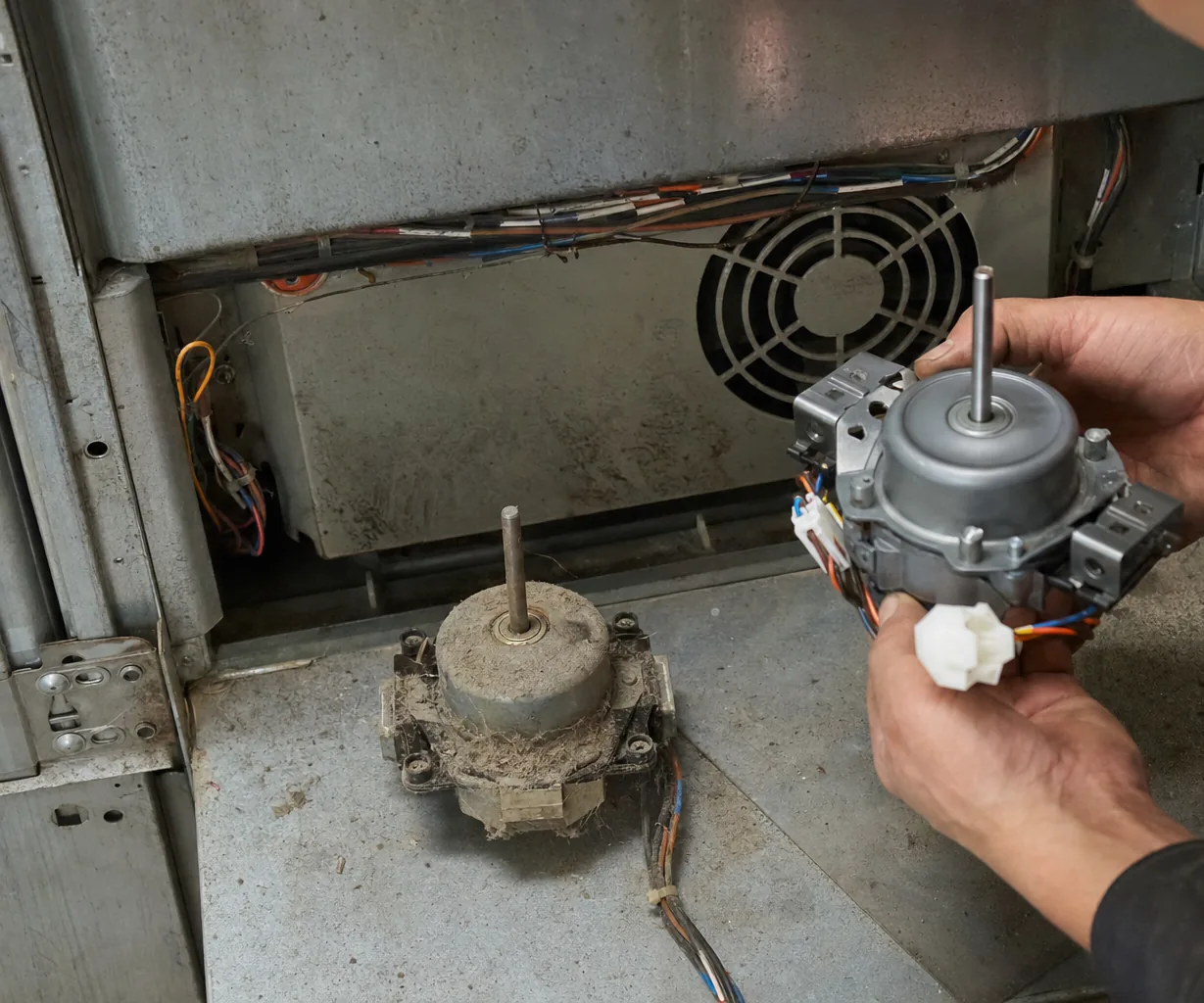
The serial plate decides which of several near-identical parts fits. Read it correctly once and the second visit never happens.
Article
Why we ask for the serial number, not just the model
Model gets you close. Serial gets you the part.
Every parts request starts with two numbers, and people usually only have the first one.
The model number tells us what the appliance is: the size, the configuration, the fuel, the generation. That is enough to talk about symptoms sensibly on the phone and to load the van with the wear items that generation is known for.
The serial number tells us when it was built, and that matters more than most owners expect. Appliance manufacturers do not freeze a design for the life of a model. Component suppliers change, an assembly gets revised, a connector changes shape, and from some point in the production run onward the correct replacement is a different item with a different number. Two ranges that look identical in two kitchens can legitimately take different parts.
Ordering off the model number alone is how a job that should take one visit takes three: wrong part, return, reorder, return again. We would rather spend five minutes reading a plate.
Where the plate is
You can find it before we arrive, and it genuinely speeds things up.
On a range, it is usually on the frame behind the bottom drawer, or on the left side of the door opening. On built-in refrigeration, look on the upper interior wall of the fresh food compartment or behind the toe grille. On a dishwasher, it is on the tub edge inside the door. Photograph the whole plate rather than transcribing it — the characters are small, stamped, and easy to mistake for each other.
What we carry and what has to come
Van stock is a judgement call, not a warehouse. What lives on the van is what fails often across the generations we see most: igniters and electrodes, oven sensors, hinge and spring sets, door gaskets, valves, spray arm assemblies, fasteners and the extraction kit for the ones that will not come out.
What has to be ordered is everything else, and the honest split looks like this.
Common mechanical parts are usually held by the distribution chain and arrive quickly. These are the parts that keep older equipment running and they are the reason a twenty-five-year-old professional range is still a sensible thing to repair.
Electronic control boards are the real variable. They are model-and-serial specific, they are not always stocked regionally, and they are the first thing to go out of production when a generation ages out. On any older unit we test the board before quoting other parts, because there is no sense fitting a pile of mechanical components to a machine whose board cannot be replaced.
Cosmetic and structural items — door skins, handles, panels, trim — are frequently the longest wait of all. They are lower-volume, they ship badly because of their size, and they are the parts most often superseded to a slightly different finish.
Supersessions, and why they are not always a straight swap
When a manufacturer replaces a part number, the new item usually fits. Sometimes it fits with a change: a different connector, an adapter harness, a revised bracket, or a mounting that expects a later revision of the surrounding assembly. That is normal in an industry where equipment stays in service for decades, and a good supersession is a genuinely useful thing.
What it means practically is that a quote has to cover the part and the change, not just the part. If a board supersession needs a harness adapter, that goes on the estimate at the time, not as an addition afterwards.
Genuine parts, and the limits of that
We fit genuine manufacturer parts. On equipment built to be repaired over a long life, that is not a preference — it is what keeps the tolerances, the ratings and the fit correct on a machine designed as a system.
There are limits worth stating plainly. We cannot obtain parts that are no longer produced, and no independent shop can. Where a component is gone for good, the options are a rebuild of the original by a specialist, a documented superseded alternative, or replacement of the appliance. We will lay those out with the numbers and let you decide.
When the answer is the manufacturer, not us
Some questions are theirs to answer and we will say so. Anything under a factory warranty should go through the manufacturer’s own channel, because we cannot claim against it for you. Safety recalls and campaign work belong with them. So does any question about whether a given serial number was part of a production change, when the answer is not published in the parts documentation.
Telling you to call someone else costs us a job. It also means that when we do say we can fix something, you can take it at face value.
Questions
Follow-ups
Why can you not just quote from the model number over the phone?
Because the model number describes the appliance and the serial number describes the build. Component suppliers change during a production run, so the correct valve, board or hinge set for your unit can depend on when it left the factory. We confirm both on site before anything is ordered.
What happens if the part turns out to be discontinued?
We tell you, in writing, and we set out the alternatives honestly: a superseded part where one exists, a specialist rebuild of the original where that is a real option, or a recommendation not to spend the money. We do not sell appliances, so that last answer costs us nothing to give.
Price Bands
What does a repair cost, band by band?
Parts and labour together, in the bands these jobs land in. The $80 diagnostic comes off the bill when you approve the work, and the firm figure is written down after the fault is proved.
| Work | Typical range |
|---|---|
| Diagnostic visit | $80 |
| Igniter or burner assembly | $200–$570 |
| Control board or touch panel | $390–$930 |
| Oven thermostat or heating element | $190–$550 |
If This Is Your Problem
The appliances this affects
Sealed burners, spark modules, oven temperature drift and the door hinges that carry a 40-pound door. 30, 36, 48 and 60 inch ranges, gas and dual fuel.
Single, double and combination wall ovens. Temperature drift, element and sensor faults, hinge and gasket wear, and control boards killed by power events.
Drop-in rangetops in 30, 36, 48 and 60 inch widths. Burner and valve work, simmer faults, griddle and grill module repair, and the counter cut-out problems nobody warned you about.
Built-in and freestanding refrigeration. Sealed-system faults, ice maker fill valves, defrost and fan faults, condenser corrosion on the coast, and door hardware.
Where It Bites
Areas where this one matters most
These are the service-area pages that turn on this problem. Each one carries its own published figures rather than repeating this article.
Our dispatch base and the shortest drive we make. The housing along the SR-13 corridor is 1990s and 2000s, so most of the equipment here is now at the age where the electronics matter.
New construction throughout, so access is rarely the obstacle. What we get called for here is wear parts reaching their age, and control boards after power events.
1970s to 1990s housing that has mostly been remodelled once, which means newer appliances in older openings and a lot of equipment now past the twenty year mark.
Older housing near the river out to 2000s and 2010s building around Oakleaf. Access is rarely the obstacle here, so the work is proving which part actually failed.
The building here is recent and the installs are sound, so access is rarely the constraint. Power events and tightly built houses account for most of what we are called out for.
Keep Reading
Next article
Burners, valves, hinges and thermostats stay available for decades. Electronics do not. Test the board first, then decide, and you will not put good money into a machine with no future.
Cabinet openings, countertop overhangs, rails, weight and the connections at the back decide how long a built-in repair takes. None of it is visible from the front, which is why we look at the installation before quoting.
Customer Comments
What customers said afterwards
4.8 out of 5, across 90 customer reviews. Every one is a single visit, in the words of the person whose kitchen it happened in.
Our range would not hold a low flame and scorched everything in a heavy pan. He stripped and soaked the burner caps, cleared two ports and reset the air shutters. It simmers again without cutting out.
A burner lit and then dropped out the moment the knob was released. He found a tired flame sensor and a loose spade connector behind the manifold, replaced one and remade the other, then tested the lot.
Next Step
Book a diagnostic
Give us the model number and what it is doing. We quote in writing before anything comes apart.
- $80 diagnostic, credited
- 90-day labor
- 365-day parts
- Mon-Fri 8am-6pm. Sat 9am-4pm. Closed Sunday.