Ours held temperature but hummed loudly at night. He isolated the evaporator fan, found a bearing dry and the blade rubbing its shroud, and replaced the assembly. Quiet again, though it took a second trip for the part.
Diagnostics
Refrigerator not cooling: start with the cheap causes, end with the compressor
Six causes of a warm Viking refrigerator in the order to rule them out: showroom mode and settings, airflow, condenser, door gaskets, fans and defrost, then the sealed system.
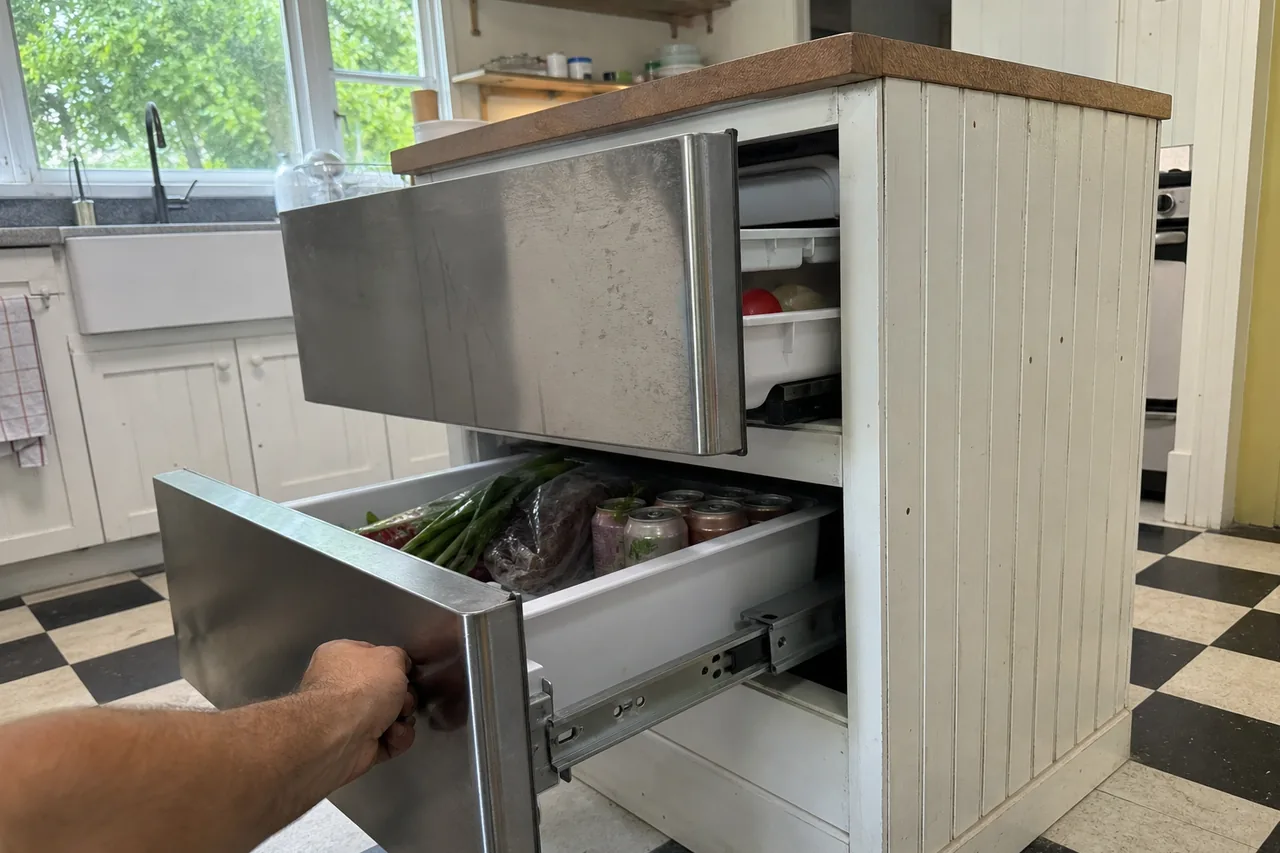
Undercounter drawers draw their air through the grille at the toe kick, so a mat or bin parked in front of it warms every drawer.
Article
Refrigerator not cooling: start with the cheap causes, end with the compressor
When a refrigerator is not cooling, rule out the cheap causes before the expensive ones: confirm it is not in showroom mode and the setting is right, clear the vents, vacuum the condenser and test the door gaskets. Only then look at the fans and defrost, and last of all the sealed system. The first four checks need a thermometer, a vacuum and a strip of paper.
Prove it is warm, and that it is allowed to cool
Measure instead of trusting the display. The USDA method suits any refrigerator: stand an appliance thermometer in a glass of water on the middle shelf, wait 5 to 8 hours, and look for 38 to 40 °F. After any adjustment, wait another 5 to 8 hours before reading again.
Next, rule out showroom mode, easy to miss on a unit bought off a display floor. Lights and display work normally while nothing gets cold. A 5 Series built-in shows SHOW; to leave, hold ACTIVATE CONTROLS and press HIGHER and ALARM OFF together until three beeps sound. On integrated VRI and VFI columns, holding VAC and ALARM for 3 seconds toggles the mode, and no fault codes appear while it is on. Some integrated models call it Demo Mode and show false temperatures; Viking tells owners to have the seller switch it off.
Then check the setting. The 5 Series ships at 38°F and 0°F, the integrated columns at 39°F and 0°F, and both need 24 hours to settle after plug-in or a change.
Let the cold air move
Cold air leaves the evaporator through vents and has to find its way back. Groceries pressed against the rear wall or a tray across a vent can starve one compartment while the other stays cold. Pull things forward and leave space around the vents.
The machine needs room outside too. Built-ins and undercounter drawers breathe through the toe-kick grille, and a mat or pet bed in front of it chokes them. After a big restock on a 5 Series, MAX REF holds the refrigerator at its coldest for four hours and FAST COOL runs the compressor at high speed for 2 hours.
Clean the condenser
The condenser releases the heat taken out of your food. Under dust and pet hair it cannot, so the compressor runs longer and the cabinet still drifts warm. Near the water, from Jacksonville Beach to Ponte Vedra Beach, salt air adds corrosion to that problem, as our salt-air guide explains.
The 5 Series has a pin-and-tube Super Clog-Resistant condenser that normally needs nothing; if dust is visible, vacuum it with a long narrow attachment. Integrated models post CHECK COND. every 6 months: hold the power key about 3 seconds, wait roughly 30 minutes, remove the grille below the door, brush-vacuum the coil, restart and reset the reminder. A blinking CL on an integrated column means the same; once the coil is clean, hold the up and down arrows for 3 seconds.
Test the door gaskets
A stiff or torn gasket lets humid air in all day, and in a Northeast Florida kitchen that moisture becomes frost on the evaporator. Close the door on a strip of paper at the top, sides and bottom; it should drag as you pull it. Viking’s quarterly routine is a wash in a quart of warm water holding 4 tablespoons of baking soda (a little mild soap also works), followed by a thin film of petroleum jelly to keep the rubber supple. On a 5 Series, HIGH TEMP means a compartment has been warm for two hours; press ALARM OFF, then find the cause.
Where owner checks stop: fans and defrost
If those checks pass and the cabinet is still warm, the fault is inside. A cold freezer with a warm fresh-food side, frost on the back panel or a new buzz or scrape all point to a fan or the defrost system. Do not remove interior panels, chip ice or keep resetting. If the display shows oPn or Shr, the temperature sensor alarm has tripped; press ALARM OFF, and if temperatures do not return, call for service at once. Fan or defrost work typically runs $240–$640, with the firm figure after the $80 diagnostic.
The sealed system is the last suspect
A compressor that runs nonstop while nothing gets cold puts the sealed system in question. Repairs there typically run $980–$2,470, confirmed after diagnosis. Check the warranty years first, and on an older unit the repair-or-replace page helps weigh the bill.
Questions
Follow-ups
How long should a refrigerator take to get cold again?
Allow a full day. Viking built-ins are designed to reach their setting within 24 hours of being plugged in or adjusted, so a warm reading an hour after a power cut or a change is not yet a fault. If it is still warm the following day, work through the checks in order.
Why is my refrigerator making a loud noise and not cooling?
A new buzz, tick or scraping sound together with rising temperatures usually points to a fan, either the one by the compressor or the one behind the freezer panel, which may be striking ice. Switch the unit off and book a diagnosis instead of letting it run, because a stalled fan makes the compressor work hot.
Is a failed compressor covered by the Viking warranty?
It can be. On Viking refrigeration the sealed system, meaning the compressor, evaporator, condenser, connecting tubing and dryer/strainer, has parts and labor coverage in years 3 to 6 and parts-only coverage in years 7 to 12. Find the purchase paperwork and the serial number before anyone quotes the job.
Price Bands
What does a repair cost, band by band?
Parts and labour together, in the bands these jobs land in. The $80 diagnostic comes off the bill when you approve the work, and the firm figure is written down after the fault is proved.
| Work | Typical range |
|---|---|
| Diagnostic visit | $80 |
| Refrigeration fan or defrost system | $240–$640 |
| Compressor or sealed-system repair | $980–$2,470 |
| Control board or touch panel | $390–$930 |
If This Is Your Problem
The appliances this affects
Built-in and freestanding refrigeration. Sealed-system faults, ice maker fill valves, defrost and fan faults, condenser corrosion on the coast, and door hardware.
Undercounter and full-height wine storage. Temperature stability, dual-zone faults, condenser airflow in tight cabinets, door seals, and sealed-system diagnosis.
Keep Reading
Next article
Salt aerosol packs condenser fin stock, seizes fasteners and eats hinge pins. The symptoms mimic a refrigerant fault, which is how coastal owners end up quoted for sealed-system work they do not need.
Cabinet openings, countertop overhangs, rails, weight and the connections at the back decide how long a built-in repair takes. None of it is visible from the front, which is why we look at the installation before quoting.
Two appliances with the same model number can take different parts depending on when they were built. This is how we identify the right one, what we carry, what has to be ordered, and how long each of those honestly takes.
Customer Comments
What customers said afterwards
4.8 out of 5, across 90 customer reviews. Every one is a single visit, in the words of the person whose kitchen it happened in.
Water collected under the crisper drawers and froze into a sheet. He cleared a blocked drain line, warmed the tube through and fitted the clip that keeps it clear. Nothing has pooled since and no parts were sold to us.
The freezer side kept frosting over. He replaced the defrost thermostat and checked the door seal all round. It has behaved since, but we waited more than two weeks for the part to land.
Next Step
Book a diagnostic
Give us the model number and what it is doing. We quote in writing before anything comes apart.
- $80 diagnostic, credited
- 90-day labor
- 365-day parts
- Mon-Fri 8am-6pm. Sat 9am-4pm. Closed Sunday.